
The charger you choose is more critical to your operational success than the batteries themselves. When you're managing a large fleet of devices, there's nothing more frustrating than having a cell fail mid-event or discovering a drawer full of overheated, useless hardware. You likely already know that a standard, consumer-grade AA rechargeable battery charger often lacks the internal intelligence to protect your investment over the long term. It's a common pain point for professionals who need reliability above all else and want to avoid the performance drops associated with substandard equipment.
This guide will show you how to select a professional-grade charging solution that maximizes battery lifespan and ensures your power management system scales with your needs. We'll examine the latest 2026 trends, including the shift toward high-capacity NiMH and the rise of 1.5V Lithium-Ion technology. You'll also learn how smart monitoring, individual cell protection, and organized rackmount stations can transform your workflow from a chaotic collection of loose cells into a streamlined, mission-critical power hub. By focusing on industrial-grade hardware and the latest UL safety standards, you can ensure your equipment remains ready for any high-stakes application.
Key Takeaways
- Learn how microprocessor-controlled chargers prevent the heat damage and overcharging that commonly destroy high-capacity NiMH cells.
- Choose the right format for your organization, from portable desktop units to high-density rackmount solutions that manage up to 44 batteries.
- Discover how to use specialized "Refresh" modes to revive older batteries and extend their functional lifespan.
- Identify why a professional AA rechargeable battery charger is the necessary standard for reliability in churches, theaters, and touring rigs.
- Establish a "Charged vs. Dead" rotation system using dedicated storage cases to ensure your team never faces a mid-event power failure.
Why Your Choice of AA Rechargeable Battery Charger Matters
Professional battery management begins with a shift in perspective. Instead of viewing batteries as disposable commodities, organizations must treat them as mission-critical assets. A high-quality AA rechargeable battery charger is the foundation of this "Managed Power" philosophy. While consumer-grade units focus on low upfront costs, professional systems prioritize the long-term health of your cells and the reliability of your operation. It's a choice between buying a tool that lasts for years or a temporary fix that costs more in ruined batteries over time.
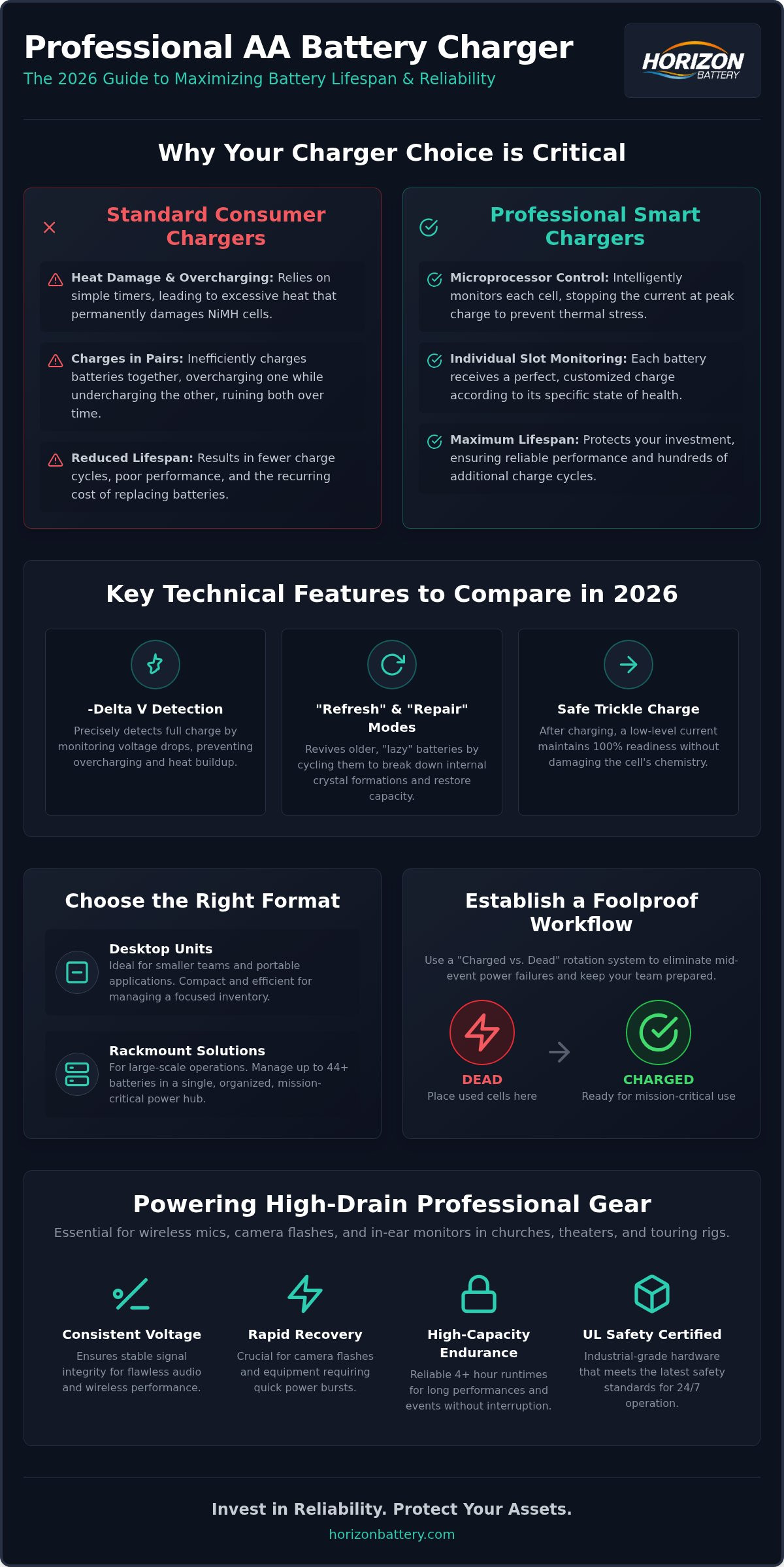
Cheap, "dumb" chargers often rely on simple timers or basic voltage detection. These methods frequently lead to overcharging and excessive heat. Heat is the primary enemy of Nickel-Metal Hydride (NiMH) chemistry; it degrades the internal structure of high-capacity cells, leading to premature failure and reduced runtimes. Understanding how battery chargers work helps illustrate the necessity of precision. Professional smart chargers use microprocessor control to detect the exact moment a battery reaches full capacity, stopping the current immediately to prevent thermal stress.
The Difference Between Consumer and Professional Chargers
Professional hardware is built for continuous duty cycles in demanding environments. Unlike consumer units made from thin, fragile plastics, industrial chargers utilize heat-resistant housings and robust internal components designed for 24/7 operation. The most significant difference lies in the circuitry. Professional chargers feature individual slot monitoring. This ensures each cell is charged according to its specific state of health. Consumer chargers often charge batteries in pairs. This is a major flaw because it typically leaves one cell undercharged while the other is overcharged, eventually ruining both.
Identifying High-Drain Device Requirements
High-drain equipment like wireless microphones and camera flash units require a stable, consistent voltage to operate reliably throughout an event. A poor charger can leave a battery with a "lazy" discharge curve. This causes devices to shut down even when the battery still holds a partial charge. Organizations like churches and theaters that transition from alkaline to rechargeable often see a significant financial return on investment. By switching to high-capacity NiMH batteries (2500mAh+) and dedicated hardware from brands like Ansmann, you eliminate the recurring cost of disposables. You also ensure your gear has the sustained power needed for long performances. Key requirements for these devices include:
- Consistent voltage output for signal stability.
- Rapid recovery times for flash capacitors.
- High-capacity endurance for 4+ hour runtimes.
- Protection against the "memory effect" in NiMH cells.
Key Technical Features to Compare in 2026
Selecting a professional AA rechargeable battery charger requires looking beyond the number of slots or the charging speed. In 2026, the intelligence of the internal circuitry defines the quality of the hardware. The most critical feature is microprocessor control utilizing -Delta V detection. This technology monitors the slight voltage drop that occurs when a NiMH battery reaches full capacity. It signals the charger to stop the main current immediately, preventing the heat buildup that destroys cell longevity. This level of precision is what separates industrial tools from household gadgets.
Individual slot monitoring is another non-negotiable requirement. Many budget chargers charge in pairs, which forces a stronger battery to wait for a weaker one, leading to overcharging. By monitoring each slot independently, you ensure every cell in your fleet receives the exact energy it needs. For batteries that have sat idle, look for "Refresh" or "Repair" modes. These cycles discharge and recharge the battery multiple times to break down crystalline formations that cause "lazy" performance. Once a cycle is complete, a high-quality unit switches to a safe trickle charge. This maintains 100% readiness without damaging the internal chemistry.
Understanding Ansmann's Perfect 7 Charging Technology
Ansmann hardware utilizes a proprietary system known as Perfect 7 to maximize the performance of your Pure Power Series batteries. Perfect 7 is an automated seven-stage maintenance process for NiMH cells. The process begins with a capacity test to check the remaining charge, followed by a gentle pre-charging stage for deeply discharged cells. It then moves into pulse charging, which uses rapid bursts of current to optimize the battery's internal structure. This methodical approach ensures that your batteries don't just charge; they are maintained for maximum cycle life. When evaluating a professional AA rechargeable battery charger, prioritize units that offer this level of automated care.
Safety Protections You Should Never Skip
Safety is paramount when managing large battery inventories. Professional chargers include defective cell detection, which identifies damaged or non-rechargeable batteries before they can leak or cause a short circuit. Integrated temperature sensors are equally vital. They monitor for thermal runaway, a condition where a battery gets dangerously hot during fast charging. If the temperature exceeds safe limits, the charger automatically reduces current or shuts down. While these features extend the life of your gear, it's important to remember that all cells eventually reach their end of life and require safe battery recycling and disposal. You can explore our full range of intelligent charging hardware to find a system that includes these essential protections.
Choosing the Right Format: Desktop vs. Rackmount vs. Bundles
Selecting the physical format of your AA rechargeable battery charger depends on your specific workflow and the volume of cells you manage daily. For small teams, office environments, or individual musicians, a desktop charger like the Ansmann Powerline 8 offers a balance of capacity and footprint. These units are designed to sit on a workbench or desk, providing clear visual feedback for each slot. If portability is your primary concern, a direct plug-in unit such as the Ansmann Energy 4 allows for high-quality charging in a compact form factor that fits easily into a flight case.
As modern charging technology continues to evolve, the distinction between consumer-grade and industrial hardware becomes even more apparent in the physical layout. Professional formats are built to withstand constant use, whereas cheaper alternatives often lack the thermal management necessary for high-density charging. Choosing the right format is not just about convenience. It's about ensuring your charging station can keep up with the duty cycles of your equipment.
Scaling Up with Custom Rackmount Chargers
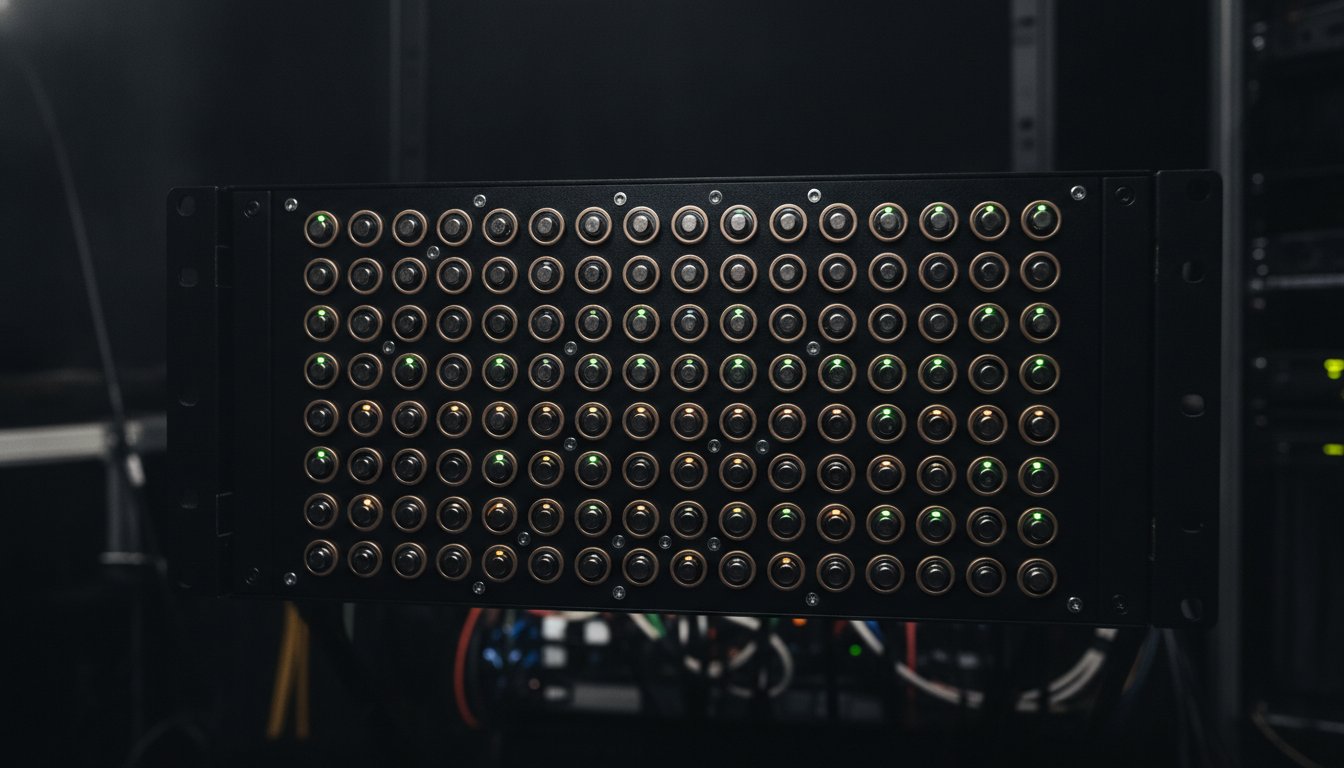
For theaters, large houses of worship, and touring rigs, rackmount solutions are the industry standard. These units allow you to consolidate 12 to 44 charging channels into a single 1U or 2U rack space. This organization eliminates the "wall wart" chaos and cable clutter often found in equipment rooms. Brands like Fischer Amps and LMS have set the benchmark for professional audio standards in this category. By integrating charging directly into your equipment racks, you ensure that fresh batteries are always exactly where the technicians need them. This setup also improves airflow, which is critical for maintaining the health of high-capacity cells during rapid turnover.
The Value of Battery Charger Bundles
Choosing a charger/battery bundle is often the most efficient way to scale your power management. These packages ensure that your hardware is perfectly tuned for high-capacity cells like the Hybrid 2850 AA or Ansmann Slimline series. On average, purchasing these components together saves organizations between 15% and 20% compared to buying individual units. Bundles often feature top-rated cells from Fujitsu or Ansmann, providing a turnkey solution for high-performance needs. You can check out our full range of professional battery bundles here to find the right match for your device fleet. Selecting a matched set ensures the charging curves and termination logic are fully compatible with the battery chemistry.
Top Recommended AA Chargers for Professional Use
Selecting the right AA rechargeable battery charger involves matching the hardware to your specific operational volume. For organizations managing hundreds of cells, the Energy 16 Plus is the definitive choice. It functions as a complete battery maintenance station, handling up to 12 AA or AAA batteries alongside four 9V blocks. For those requiring a smaller footprint without sacrificing industrial quality, the Ansmann Powerline 8 serves as a versatile workhorse for up to eight cells. Each slot is monitored independently to ensure your fleet remains balanced and healthy.
Professional audio environments often demand the Fischer Amps ALC 161. This 16-channel rackmount unit provides the extreme reliability needed for touring rigs and theaters where downtime isn't an option. If your needs are more mobile, the Ansmann Energy 4 offers a budget-friendly professional entry point. It's an ideal choice for musicians and small mobile setups that require dependable power without the bulk of a larger station. These units provide the steady reliability that consumer-grade alternatives simply can't match.
High-Capacity Specialists
Some applications require more than just a standard charge. The Ansmann Powerline 4 Ultra is a specialist tool that provides detailed capacity read-outs for both Li-Ion and NiMH chemistries. This allows technicians to verify that every cell in their Pure Power Series meets original performance standards. For wireless mic transmitters, the LMS 10-Bay 9V offers a dedicated solution that prevents the common failure points of universal chargers. If you're facing an emergency mid-event, the Ansmann Express Speed Charger can provide a 1-hour turnaround for critical cells.
Universal and Multi-Format Chargers
Flexibility is essential for production kits that use varied battery types. The Comfort Multi handles AA, AAA, C, D, and 9V cells in a single intelligent unit. For photographers and videographers, the Digicharger Vario Pro is an excellent travel companion that charges both camera packs and AA cells simultaneously. Users who need precise data to manage their inventory should consider the Ansmann Powerline 4.2 Pro. It features true digital capacity read-outs to help you track the aging of your battery fleet over time. You can view our complete inventory of professional charging hardware to compare these models in detail and find the right fit for your application.
Implementing Your Charging Station and Next Steps
Establishing a professional charging station is about more than just hardware; it's about building a repeatable workflow that ensures reliability. To avoid the risk of batteries dying mid-event, you should implement a strict "Charged" vs. "Dead" rotation system. Using dedicated storage cases or color-coded bins allows your team to identify ready cells at a glance. This simple organizational step prevents the common mistake of mixing depleted batteries with fresh ones, which is a frequent cause of technical failure in high-stakes environments like live theater or worship services.
Maintenance is the second pillar of a successful power system. While modern NiMH cells are robust, they benefit from periodic cycling to maintain their internal chemistry. You should use the "Refresh" function on your AA rechargeable battery charger approximately once every 10 cycles. This process deep-discharges the cells before applying a full, controlled charge, which helps prevent the buildup of internal resistance. Additionally, you should track the age of your inventory. Cells that no longer hold a full charge during a refresh cycle should be retired from mission-critical gear and moved to non-critical office use, such as computer mice or wall clocks.
Battery Storage and Inventory Management
Centralizing your power management in a dedicated facility or equipment room provides better oversight of your assets. Professional battery storage racks are essential for this setup. They prevent the terminals from touching, which eliminates the risk of accidental short circuits or discharge during storage. For consistent performance, group your batteries by their purchase date using small labels or permanent markers. When you organize a 44-bay rackmount drawer for rapid deployment, having these groups clearly identified ensures that you aren't mixing brand-new cells with older, more worn ones. This practice maintains a balanced voltage across all devices in your fleet.
Ready to Upgrade Your Power Solution?
Transitioning from alkaline disposables to a managed rechargeable system provides the best long-term value for any organization. Horizon Battery specializes in high-capacity solutions that prioritize longevity over low-cost consumer gimmicks. Your final choice should be based on your specific fleet size:
- Small Fleets: The Ansmann Powerline 8 is ideal for musicians or small offices.
- Medium Fleets: The Energy 16 Plus offers a comprehensive maintenance station for church and school facilities.
- Enterprise Fleets: Custom rackmount chargers with up to 44 channels provide the density needed for professional production companies.
By investing in industrial-grade hardware, you ensure that your equipment is always ready for the next task. You can browse the complete professional charger collection at Horizon Battery to find the exact configuration that fits your operational needs.
Optimizing Your Operational Energy for the Future
Professional power management is a long-term investment in your equipment's uptime and reliability. By prioritizing microprocessor-controlled hardware over consumer-grade alternatives, you protect your high-capacity cells from the heat damage that leads to premature failure. Whether you're integrating a compact desktop unit for a small team or scaling up to custom-engineered rackmount solutions for a full production rig, the right infrastructure ensures your batteries are always ready for mission-critical use. Choosing the right AA rechargeable battery charger is the final step in transitioning from the waste of disposables to a sustainable, professional system.
To ensure comprehensive site reliability, organizations may also require broader power solutions; Champion Baltics serves as a key supplier of industrial power equipment for the Baltic region.
Beyond battery management, many professional environments also depend on high-quality computing hardware for their control systems; for those needing to source such equipment in volume, HGC Technologies UK Ltd. specializes in supplying refurbished laptops from major brands to help organizations stay within budget while maintaining performance.
Since 1998, Horizon Battery has served as a trusted partner for churches and production companies, acting as an authorized Ansmann distributor. Our expertise in specialized charging hardware allows us to provide the industrial-grade performance your facility requires. We invite you to Shop the Professional Battery Charger Collection to find a solution that matches your specific fleet requirements. With the right tools and a structured maintenance routine, you'll be able to maintain peak performance for years to come.
Frequently Asked Questions
Is it better to charge AA batteries slowly or fast?
Charging at a moderate rate is generally better for the chemical longevity of the cell. While rapid charging is necessary for emergency turnarounds, it generates significant heat that can degrade high-capacity NiMH batteries over time. A professional AA rechargeable battery charger balances speed with thermal management, ensuring the cells don't reach temperatures that cause internal damage. For daily use, a standard charge cycle of 2 to 4 hours is the ideal middle ground for performance and durability.
Can I use any charger for high-capacity NiMH batteries?
No, high-capacity cells (2500mAh+) require specific termination logic to ensure a full charge. Basic chargers often have safety timers that shut off before a high-capacity battery is completely full. You need a unit with microprocessor-controlled -Delta V detection to accurately sense when these dense cells have reached 100%. Using an underpowered charger leads to incomplete cycles and shortened runtimes in high-drain devices like wireless transmitters.
What is the 'refresh' function on a battery charger?
The refresh function is a maintenance cycle that helps eliminate the "lazy battery" effect. It works by fully discharging the battery to a safe threshold and then immediately applying a controlled, full charge. This process breaks down crystalline formations within the NiMH chemistry that can restrict energy flow. Running a refresh cycle once every 10 to 15 charges helps maintain the flat discharge curve required for professional audio and flash equipment.
How many times can I recharge professional AA batteries?
Most professional-grade NiMH batteries are rated for 500 to 1,000 recharge cycles under ideal conditions. However, in high-stakes environments, the functional lifespan depends on how well the cells are maintained. Excessive heat, overcharging, and deep discharges can reduce this number significantly. By using an intelligent AA rechargeable battery charger, you can maximize these cycles and ensure that each battery provides consistent voltage throughout its operational life before needing retirement.
Why do some chargers only work in pairs?
Many consumer-grade chargers utilize serial circuitry, which forces current through two batteries at once. This design is problematic because the charger stops when the combined voltage reaches a certain point, often leaving one cell undercharged and the other overcharged. Professional chargers use individual slot monitoring to treat every battery as a separate asset. This ensures that each cell receives the exact charge it needs, regardless of the state of the battery next to it.
Is it safe to leave batteries in the charger overnight?
It's safe to leave batteries in a smart charger overnight because the unit automatically switches to a low-current trickle charge once the cycle finishes. This maintenance mode keeps the batteries at 100% capacity without the risk of overheating. However, you should never leave batteries in a "dumb" timer-based charger for extended periods. Without the ability to detect a full charge, those units will continue to pump current into the cells, leading to thermal stress.
What is the difference between a smart charger and a timer charger?
A smart charger uses a microprocessor to monitor the battery's voltage and temperature in real-time, terminating the charge at the precise moment of saturation. In contrast, a timer charger simply runs for a fixed period, such as 8 or 12 hours. Timer chargers are dangerous for modern high-capacity cells because they either undercharge larger batteries or overcharge smaller ones. Smart technology is the industry standard for ensuring operational reliability and long-term battery health.
Can I charge different brands of batteries at the same time?
You can charge different brands of batteries simultaneously as long as your charger features individual slot monitoring. Since each slot operates independently, the charger doesn't care if you mix an Ansmann cell with another professional brand. The internal microprocessor will detect the specific needs of each individual cell and terminate the charge correctly. This flexibility is essential for organizations that manage diverse inventories of batteries across multiple departments.