
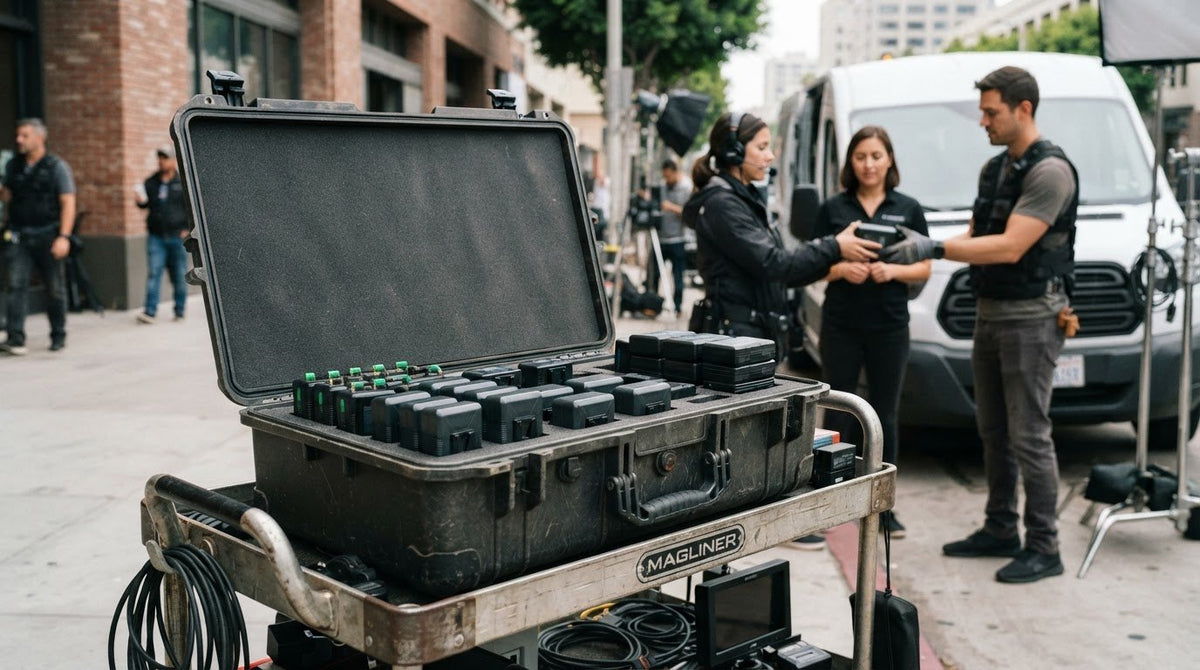
A rugged battery case is more than a protective shell. It’s part of the on-set power workflow. The right rugged battery carrying cases for production crews help organize battery types, keep charged cells separate from depleted ones, and make handoffs easier when the schedule is moving.
It’s easy to focus on impact protection and overlook the layout. A case that wastes space or makes batteries hard to identify can slow a crew down just as surely as a damaged cell can disrupt a shoot. Choose a setup that fits your inventory and moves easily between vehicles, carts, locations, and work areas.
This 2026 buying guide explains how to match case capacity and compartments to your battery mix, assess inserts and labeling, and reduce preventable handling damage. It also covers transport considerations, including why a hard case shouldn’t be assumed to meet air-transport requirements. Use the checklist to find a case that protects your power supply and supports efficient on-set handoffs.
Key Takeaways
- Compare hard-shell, aluminum, and soft-sided designs by their practical trade-offs. Check the specific case’s documentation before relying on protection claims.
- Choose rugged battery carrying cases for production crews by counting your cells, grouping them by device or chemistry, and allowing room for reserves and easy access.
- Use consistent labels for battery chemistry, charge state, and assigned kit so crew members can identify the right cells during handoffs.
- Assess usable capacity, not just advertised capacity. Inserts, padding, labels, and access space all affect how much inventory fits.
- Balance a fitted interior’s organization against an adjustable layout’s flexibility, based on how often your battery inventory changes.
Why production crews need more than a tough battery case
A battery case earns its place in a production kit when it helps protect batteries during transport and makes the right cells easy to find. A road case is a protective container used to transport sensitive equipment, as described in this overview of the road case. For batteries, ruggedness is only part of the job. Compartments and clear labels help crew members tell what’s ready to use, what’s depleted, and which kit each battery belongs to.
A protective battery case stores and organizes batteries for transport. It doesn’t charge them or track their condition by itself. A case can support an inventory routine, but charging hardware and crew procedures do separate jobs. Treat the case as one part of the production power workflow, not as a complete charging or inventory system.
What production battery cases need to protect against
Battery kits may move from a vehicle to a cart, through storage, and across a location before reaching a work area. Consider vibration, accidental drops, dust, moisture, and frequent opening and closing. A secure closure and an interior that holds batteries in place can help limit movement during ordinary handling.
Protection depends on the complete design: construction, closure, interior fit, and verified product ratings. Don’t assume a hard shell is waterproof, impact-rated, or suitable for temperature extremes based on appearance alone. Check documentation for the specific case and intended use. Inserts need the same attention: cells should fit securely without becoming difficult to remove or inspect.
Why organization matters as much as durability
A well-organized interior can reduce searching during a handoff. Fixed compartments may suit an inventory that stays consistent, while removable dividers can adapt to changing equipment needs. Keep battery types separate rather than relying on memory, and store charged and depleted cells apart so a quick return to the case doesn’t create confusion.
- Label battery chemistry and device assignment clearly.
- Mark charge status using a consistent method understood by the whole crew.
- Return depleted cells to a designated section instead of mixing them with ready-to-use batteries.
These steps make rugged battery carrying cases for production crews more useful on busy workdays, when several people may access the same kit. Organization doesn’t replace charging or battery-management practices. It helps the crew follow them consistently. Before choosing a case, match its layout to the batteries you carry and verify its protection claims for the conditions you expect.
Compare rugged battery case materials, interiors, and portability
When comparing rugged battery carrying cases for production crews, assess the complete setup, not just the shell material. A case that travels in a vehicle and gets handled repeatedly has different priorities from an organizer kept on an indoor cart. Weight, access, usable space, and the battery mix all affect which format will work best.
Hard-shell, aluminum, or soft-sided: which format fits the job?
Rigid polymer shells provide a structured enclosure without the feel of a metal case. Aluminum cases also offer a rigid format, but their weight and durability depend on construction and design. Soft-sided organizers may be easier to carry and access in controlled settings, though their structure and protection can differ from rigid options. These are general material tendencies, not guarantees about a particular case.
Check the product documentation and inspect how the case is made. Latches, handles, seams, and closures should suit the way the crew will move and open it. Verify published protection ratings rather than assuming material or a rugged appearance ensures resistance to impact, dust, or moisture. For air travel, review the FAA regulations for lithium batteries and confirm requirements for your specific batteries and itinerary.
Hard-shell polymer
General characteristic: a rigid enclosure that may balance structure with manageable carry weight. Verify the specific shell construction, closure, protection ratings, and interior dimensions.
Aluminum
General characteristic: a rigid case format for crews that prioritize a structured enclosure. Verify actual loaded weight, edge and latch construction, and the case’s stated protection performance.
Soft-sided
General characteristic: a flexible format that may support quick access and lighter indoor or cart-based use. Verify padding, seams, closure, and whether its structure suits your transport conditions.
Choose an interior that fits the battery mix
Interior layout determines whether batteries stay separated and accessible. Foam can hold a consistent set snugly, but fixed cutouts may waste space if the inventory changes. Molded compartments provide defined positions, so confirm that each one fits the cells you use. Adjustable dividers can better accommodate a changing mix, provided they keep batteries from shifting during movement.
Plan for AA rechargeable cells alongside any specialty formats your crew actually carries. Check the fit with the batteries in hand, including how easily crew members can remove and return them. Padding and dividers reduce usable space, while a larger or more protective construction can affect total carry weight. Protection, usable capacity, and price vary by model, so compare documented specifications and the packed load.
For the broader power workflow, you can also explore battery storage and charging options and verify compatibility with your inventory.
How to size a battery carrying case for your production crew
Start with the batteries your crew uses, not the dimensions of a case that looks suitable. Case capacity should follow the working inventory, not the maximum advertised volume. Nominal capacity describes the space a case appears to offer. Usable capacity is what remains after compartments, padding, labels, and the space needed to remove cells are accounted for.
Build an inventory before comparing case dimensions
Use this four-step process to turn your crew’s power needs into a practical case specification:
- Count cells. Record the number of batteries currently assigned to the production kit.
- Group by device or chemistry. Note each format, what it powers, and whether it needs a separate compartment.
- Plan reserves. Set aside the reserve stock the crew expects to carry instead of adding batteries without a defined need.
- Measure the packed load. Include batteries, dividers or foam, labels, and anything else intended to travel in the case.
Compare the packed load with the case’s interior dimensions and stated capacity. Check the total loaded weight against how the case will move, whether by hand, on a cart, or in a vehicle. If batteries will travel by air, check current FAA regulations on lithium batteries and confirm the rules for the specific batteries and itinerary.
Inventory worksheet
- Battery format or chemistry: [enter type]
- Assigned device or kit: [enter assignment]
- Current working quantity: [enter count]
- Expected daily demand: [enter crew estimate]
- Reserve quantity: [enter planned reserve]
- Packed dimensions and loaded weight: [measure completed load]
- Transport method and access needs: [enter details]
Plan for labels, reserves, and quick access
Mark separate locations for charged, depleted, and reserve batteries. Leave room for labels identifying chemistry and device assignment, and keep frequently used cells reachable without removing the rest of the load. A compartment may fit cells tightly but still be impractical if crew members struggle to return them during a handoff.
Allow for reasonable inventory changes, but avoid sizing around a hypothetical maximum that makes the case unnecessarily bulky. For rugged battery carrying cases for production crews, a worksheet based on actual inventory makes it easier to compare usable space, handling, and transport fit before choosing a case.
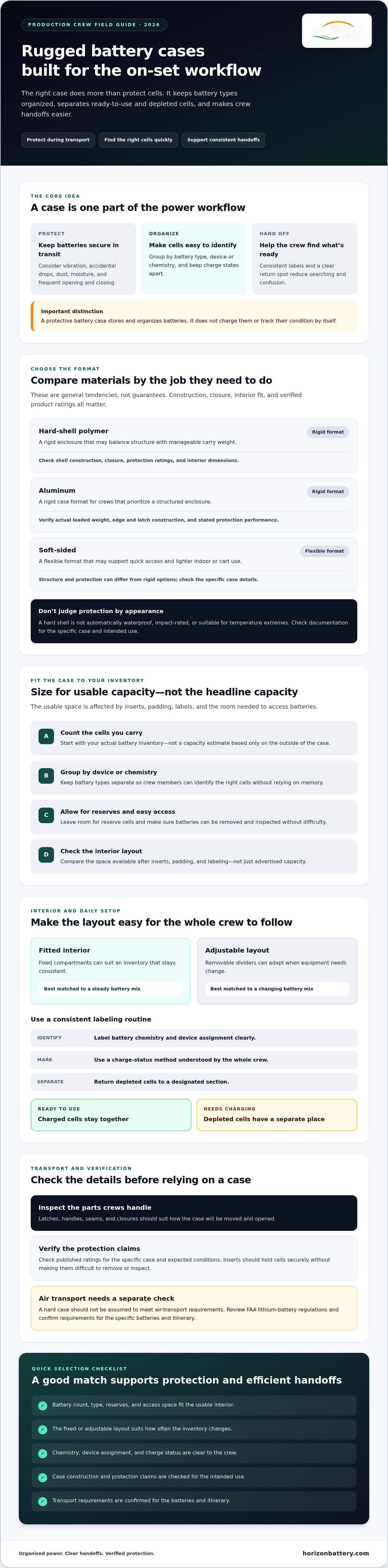
Set up battery cases for safe, efficient daily use
A useful case layout works best when the crew follows the same routine each day. Use a consistent label or color system to identify battery chemistry, assigned device or kit, and charge state. Keep the system simple and visible to everyone. For example, mark compartments “charged,” “depleted,” or “reserve,” and pair each with a clear kit or battery-type label. Don’t rely on color alone when labels can make the system easier to interpret.
Keep charging equipment organized separately from stored cells unless the equipment is specifically designed to be carried together. A carrying case helps protect and sort inventory. It isn’t a charger or a substitute for battery-management procedures. For broader inventory practices, review the professional battery storage and management system guide.
Create a clear charged-and-depleted battery workflow
Set aside clearly labeled compartments or removable trays for each charge state. At the start of the day, the assigned person can count the ready-to-use cells and check that reserves are present. During a department handoff, confirm what was issued and returned, then place depleted batteries in their designated area instead of mixing them with the charged supply.
At wrap, the responsible person or department should reconcile the case against the inventory, return batteries to their assigned positions, and record missing cells or damaged packaging before the next shift. A brief written or digital count clarifies who has the kit and what needs attention without slowing routine exchanges.
Check transport and battery-specific guidance
Follow the battery manufacturer’s instructions for storage, handling, and temperature conditions. If the crew is flying, review current FAA guidance for lithium batteries and check the carrier’s requirements for the exact battery type. Keep this review separate from case selection: a case’s appearance or marketing language doesn’t establish a protection rating or travel approval.
- Start of day: Count charged cells and confirm reserve stock.
- Handoff: Record issued and returned batteries, then separate depleted cells.
- End of day: Reconcile the inventory and note missing or damaged items.
A consistent routine makes rugged battery carrying cases for production crews easier to manage across departments and shifts. To coordinate the case workflow with your power setup, explore battery storage and charging options and confirm compatibility with your inventory.
Choose a battery case solution that fits your power system
The right choice fits the batteries your crew uses and the way they move through a production day. Buying a case is separate from buying batteries or charging equipment unless compatibility has been confirmed. Treat rugged battery carrying cases for production crews as one part of the power setup, then check that the layout, protection claims, and transport format suit your workflow.
Use a final checklist before placing an order
Compare the case’s documented specifications with your packed inventory and transport needs. Ask the supplier for details that aren’t clear in the product information, including:
- Internal dimensions and compartment layout, checked against the batteries and any included accessories.
- Empty weight and estimated loaded weight for the intended transport method.
- Closure details, including how the case stays shut during routine handling.
- Documentation for any stated impact, dust, water, or temperature ratings.
- Return terms and available support, confirmed directly with the case supplier.
A custom interior may suit a stable battery inventory that benefits from a close-fitting layout. Adjustable dividers can work better if the crew’s battery mix changes. In either case, check usable room and access with the batteries in place rather than relying on advertised volume alone.
Match the case to batteries, storage, and charging
Confirm the chemistry and cell formats supported by your batteries, then check that the case compartments suit those cells. Review chargers and storage arrangements separately. A carrying case doesn’t charge batteries, and a fit between the case and cells doesn’t confirm compatibility with charging equipment. Connect these decisions through an inventory plan, but verify each product’s specifications on its own.
Horizon Battery’s product categories include rechargeable batteries, battery storage, and charging products. If you’re developing the charging side of the workflow, the enterprise battery charging solutions buying guide can help frame that decision. Check directly with the supplier for current case availability and compatibility before purchasing, as a specific rugged carrying case isn’t confirmed here.
Before ordering, check that the case fits the working inventory, provides documented protection suited to its use, allows quick access, stays manageable when loaded, and suits the transport method. Clear answers help you choose a case that supports the wider power system without expecting one product to do every job. Explore rechargeable batteries, battery storage, and charging options as complementary parts of that setup.
Build a battery workflow your crew can rely on
The right case supports more than transport. It fits the crew’s working inventory, keeps cells accessible, and makes charged, depleted, and reserve batteries easy to distinguish. Before choosing, verify the case’s usable space, weight, closure, and protection claims against how your team will carry and use it. A consistent labeling and handoff routine turns that layout into a dependable part of the production workflow.
Use these criteria to compare rugged battery carrying cases for production crews, and keep case selection separate from decisions about batteries and charging equipment unless compatibility is confirmed. Horizon Battery has served customers throughout the United States and Canada since 1998. Its offerings include rechargeable batteries, battery storage, and custom charging hardware. Verify case availability and compatibility directly.
To explore battery and storage options for your power setup, explore Horizon Battery’s professional battery and storage solutions. A case matched to your inventory and a clear crew routine can help your team manage on-set battery handoffs with greater confidence.
Frequently Asked Questions
What should a rugged battery carrying case for a production crew include?
Look for a secure closure, an interior layout that fits the crew’s battery formats, and clearly identified spaces for charged, depleted, and reserve cells. Dividers or fitted compartments can help prevent batteries from shifting and make handoffs easier. Check the case’s dimensions, empty and loaded weight, and documented protection ratings. Don’t assume a rugged appearance guarantees impact, dust, water, or temperature protection.
How do I choose the right size battery case for a film crew?
Size the case around the inventory your crew expects to carry. Count batteries, group them by device or chemistry, plan reserve stock, then measure the packed load, including padding, dividers, labels, and access space. Compare those measurements with the case’s internal dimensions, not just its advertised volume. Consider loaded weight and how the case will move between vehicles, carts, and work areas.
Are hard-shell or soft-sided battery cases better for production crews?
Neither format is automatically better. Choose based on the conditions and handling your kit will face. A hard shell offers a structured enclosure, while a soft-sided organizer may suit controlled indoor use or cart storage where lighter carry and easy access matter. Compare construction, closure, handles, seams, and interior fit. Verify product-specific protection ratings rather than inferring performance from material or appearance alone.
Can I store different types of rechargeable batteries in the same case?
Yes, if the layout keeps each format identifiable and secure, and the batteries are stored according to their manufacturers’ instructions. Use separate, labeled compartments or dividers for different chemistries or device assignments. Don’t let loose cells move around together, and keep charged and depleted batteries distinct. Check that compartments fit each battery type, particularly if the kit includes both AA and specialty formats.
How should a production crew separate charged and depleted batteries?
Assign separate compartments or removable trays and label them clearly as charged, depleted, and reserve. Use the same system across the crew, with labels that remain readable during routine handling. At handoff, record batteries issued and returned, then place depleted cells in their designated area. At the end of the day, reconcile the count and document missing batteries or damaged packaging before the next shift.
Can I take rechargeable batteries in a production case on a plane?
It depends on the battery type, watt-hour rating, airline, and whether the batteries are spares. FAA guidance generally allows lithium-ion batteries up to 100 watt-hours for passenger use. Batteries from 101 to 160 watt-hours require airline approval and are limited to two spare batteries. Spares must go in carry-on baggage. Check current FAA guidance and your airline’s rules for the exact batteries and trip. A case alone doesn’t establish travel approval.
Does Horizon Battery sell rugged carrying cases for production crews?
Horizon Battery’s offerings include high-capacity rechargeable batteries, charger and battery bundles, battery storage, and custom rackmount chargers. A specific rugged carrying case for production crews isn’t confirmed, so check directly with Horizon Battery about current case availability and compatibility before purchasing. Keep case selection distinct from battery or charging decisions, and verify each product’s specifications for your inventory and workflow.