
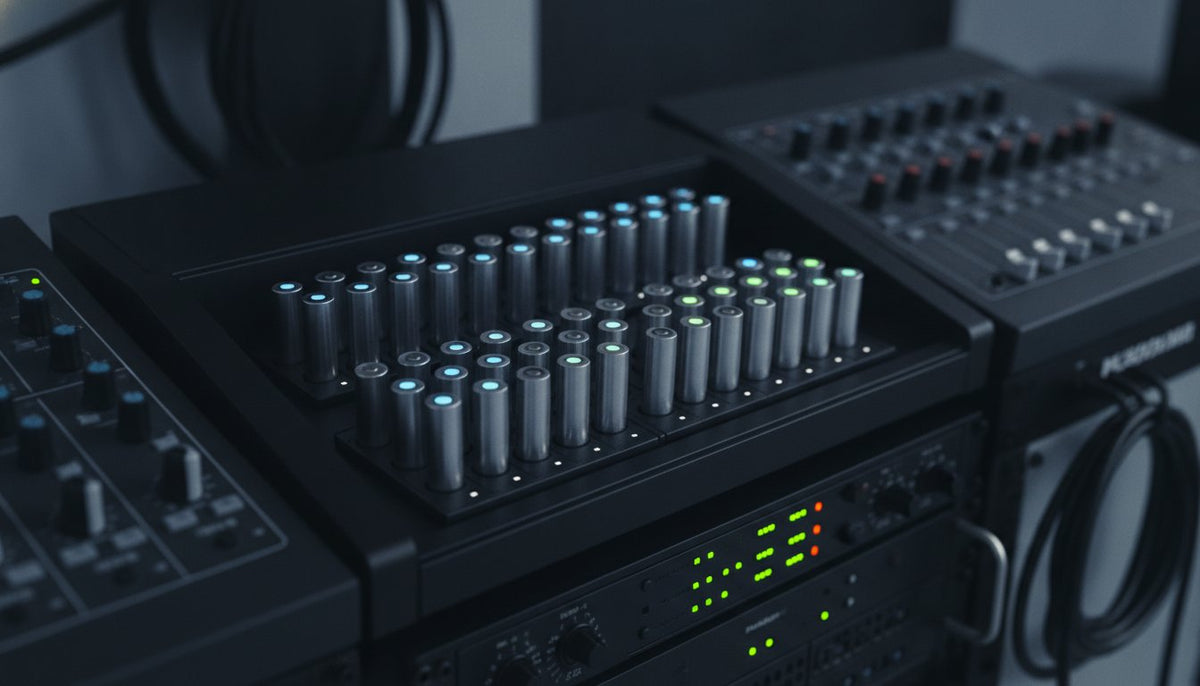
Voltage stability, not mAh capacity, is the true metric of professional battery reliability in 2026. If you've ever had a wireless microphone cut out despite a "full" indicator, you know that traditional power metrics often fail in high-stakes environments. When evaluating the Pure Power Series vs NiMH for your equipment locker, the choice involves more than just selecting a brand. It's about understanding how constant 1.5V regulation prevents the mid-performance failures that plague standard rechargeable cells.
We understand the pressure of managing large-scale events where gear fitment and battery telemetry are critical. It's frustrating to manage the high cost of alkaline disposal while dealing with NiMH cells that lose their punch exactly when you need it most. This guide will help you master the technical differences between 1.5V Lithium-ion and traditional NiMH to eliminate power failures and optimize your facility ROI. We'll explore standardized charging workflows for large teams and show you how to achieve zero technical failures through better power management.
Key Takeaways
- Learn how 1.5V constant voltage regulation prevents premature "low battery" indicators on professional wireless transmitters.
- Evaluate the Pure Power Series vs NiMH to determine which chemistry offers the best energy density for your specific high-drain applications.
- Solve fitment challenges in tight equipment slots by understanding the dimensional differences between consumer and professional-grade rechargeable cells.
- Streamline facility operations with standardized charging workflows and custom rackmount solutions designed for enterprise-level asset management.
- Analyze long-term ROI by comparing runtime stability and lifecycle costs between traditional NiMH and modern 1.5V Lithium-ion systems.
The Voltage Gap: Why Your Gear Thinks Your Batteries Are Dead
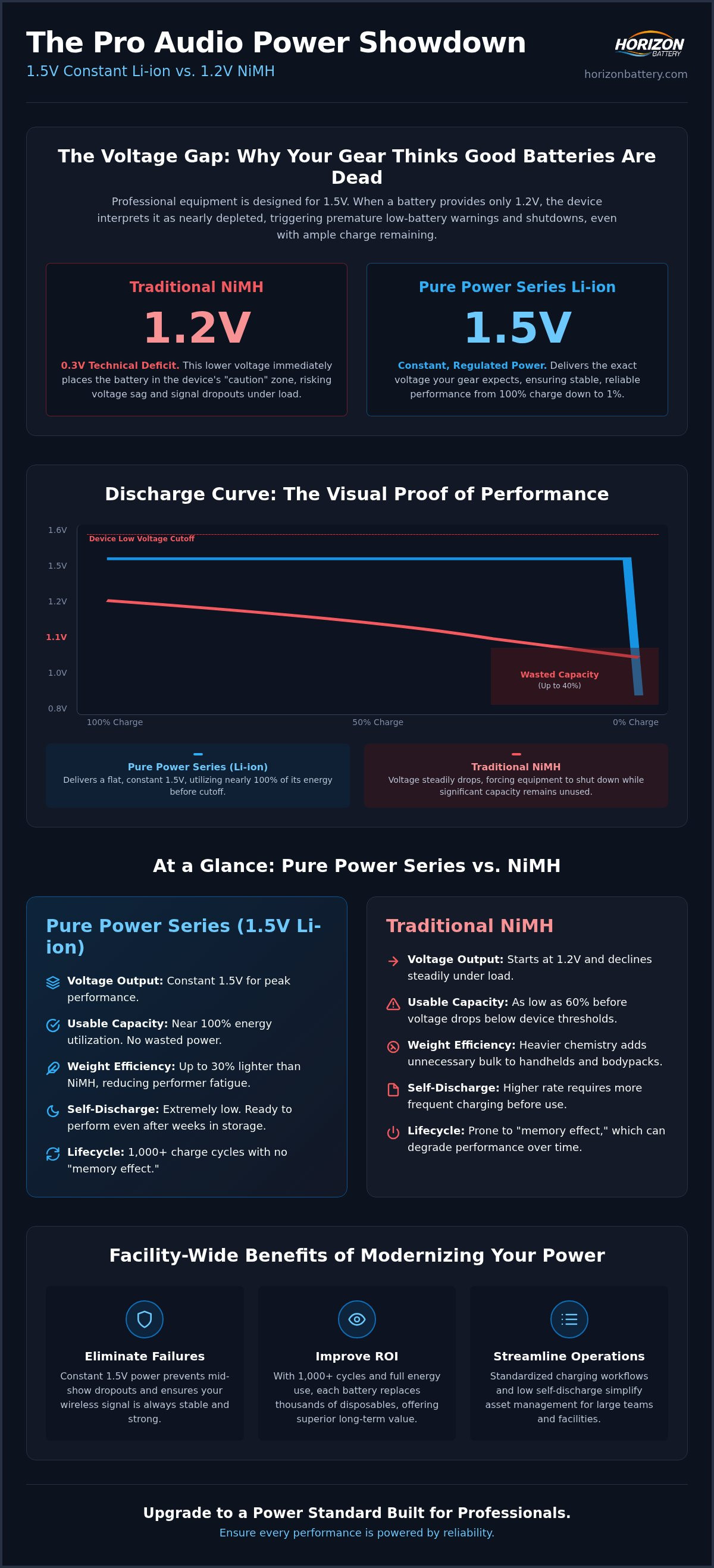
Professional wireless transmitters and digital mixers are engineered around a specific power profile. Most of this gear was originally designed to operate on the 1.5V nominal output of alkaline cells. When you introduce Nickel-metal hydride (NiMH) batteries into these systems, you're starting with a technical deficit. NiMH cells provide only 1.2V at full charge. This 0.3V difference might seem negligible, but it represents the margin between a stable signal and a mid-show failure.
The "Low Battery Warning Threshold" is the predetermined voltage level at which a device's firmware triggers a shutdown or alert to ensure operational stability and prevent signal clipping. When comparing the Pure Power Series vs NiMH for mission-critical applications, the most significant factor isn't total capacity; it's the voltage floor. If your device expects 1.5V and receives 1.2V, the internal circuitry interprets this as a battery nearing the end of its life, even if it's freshly charged.
Voltage sag further complicates this issue. This is the temporary drop in output voltage that occurs when a transmitter draws peak power for signal bursts. In a battery already operating at its lower limit, voltage sag can push the output below the device's operational threshold, causing intermittent dropouts or total resets. High mAh ratings on a battery label are often misleading because they measure total energy, not usable energy above the cutoff voltage of your specific gear.
The Problem with NiMH Discharge Curves
NiMH batteries exhibit a characteristic downward slope in their discharge curve. As soon as you begin using the device, the voltage begins to slide from 1.2V toward 1.0V. This gradual decline causes "early warnings" on professional gear, leading many technicians to swap batteries that still have 40% of their chemical capacity remaining. You're effectively paying for energy you can never use because the voltage drops too low for the equipment to stay powered.
The Pure Power 1.5V Constant Output Advantage
The Pure Power Series vs NiMH debate often centers on convenience, but the technical reality of voltage regulation is what actually determines show reliability. Pure Power Series batteries utilize an internal buck-boost converter to maintain a flat, constant 1.5V output until the cell is nearly exhausted. This eliminates the guessing game of battery indicator bars. Your signal remains strong and your transmission range stays consistent because the transmitter's RF stage receives the exact voltage it was designed to handle from start to finish.
Energy Density and Weight Efficiency
Lithium-ion chemistry offers a vastly superior energy-to-weight ratio compared to nickel-based alternatives. For technicians managing handheld microphones or belt packs, this translates to a tangible reduction in gear weight. A standard high-capacity NiMH cell is significantly heavier than its Li-ion counterpart, often by as much as 30%. Over a long production day, this weight reduction improves performer comfort and reduces the mechanical strain on mounting clips and battery pouches. Additionally, Li-ion cells manage heat dissipation more effectively during high-drain operation, which helps keep sensitive internal electronics within safe thermal operating ranges.
Charge Cycles and Long-Term Lifespan
Modern professional NiMH solutions are known for their durability and high cycle counts. However, Li-ion technology has matured to meet or exceed these benchmarks in professional environments. While NiMH cells can face performance degradation if left partially charged or stored incorrectly, the Pure Power Series is immune to the "memory effect" and features a remarkably low self-discharge rate. You can charge these cells and leave them in a storage case for weeks without losing significant capacity. If you're looking to modernize your inventory, exploring Pure Power Series options can help you transition to a more efficient chemistry.
From an environmental perspective, the extended lifecycle of these modern chemistries significantly reduces the volume of hazardous waste compared to single-use alkalines. The ability to reach 1,000 or more charge cycles means a single pack of rechargeable batteries can replace thousands of disposables over its functional life. This longevity, combined with the safety provided by internal IC protection, makes the shift from traditional nickel chemistries to advanced lithium solutions a logical step for facility managers focused on long-term ROI. By selecting the right chemistry, you ensure that your power source lasts as long as the equipment it supports.
Performance Benchmarks: Runtime, Stability, and ROI
Runtime in professional environments is often misunderstood as a simple capacity measurement. While a battery might be rated for 2850mAh, its real-world performance depends on how long it can maintain the voltage required by the internal circuit. When comparing the Pure Power Series vs NiMH, the difference becomes apparent in high-drain digital wireless transmitters. For detailed technical specifications on traditional nickel-based cells, refer to our Ansmann high capacity batteries guide.
Environmental stability is another critical benchmark. Professional productions often move between extreme temperatures, from outdoor summer festivals to climate-controlled broadcast studios. NiMH batteries are known to lose significant capacity when exposed to cold environments, leading to unexpected shutdowns. In contrast, the 1.5V Lithium-ion chemistry in the Pure Power Series remains stable across a wider thermal range; this ensures consistent performance whether you are on a frozen stage or under heavy stage lighting.
High-Drain vs. Low-Drain Applications
Choosing the right battery requires matching the chemistry to the specific power draw of your inventory. For low-drain devices such as wall clocks, remote controls, or simple door locks, NiMH options like the Ansmann Hybrid are often the most cost-effective choice. These devices don't require the high-voltage floor that digital audio gear demands. However, for In-Ear Monitors (IEMs) and wireless microphones, the Pure Power Series vs NiMH debate ends quickly. The constant 1.5V output is non-negotiable for maintaining signal integrity and preventing the voltage sag that causes digital dropouts in modern RF systems.
Calculating Total Cost of Ownership (TCO)
The Professional ROI looks at the total expenditure over a two-to-three-year cycle rather than the initial purchase price. While the upfront cost of Lithium-ion is higher than NiMH or alkaline, the cost per charge cycle is dramatically lower. A single set of professional rechargeables can replace hundreds of packs of alkaline batteries. This eliminates recurring procurement costs and the logistical burden of hazardous waste disposal. The Pure Power Series reduces labor costs in battery management by providing predictable runtimes that allow technicians to standardize their swap schedules across large teams. This predictability prevents the emergency battery changes that disrupt rehearsals and live performances.
Solving the Physical Fitment and Charging Dilemma
Professional AV technicians often encounter the "tight slot" problem during high-pressure setups. While the AA form factor is technically standardized, high-capacity cells frequently push the upper limits of these dimensions. In the Pure Power Series vs NiMH evaluation, physical fitment is just as critical as electrical performance. Some high-capacity NiMH cells use thicker outer casings to accommodate more chemical material, which makes them difficult to insert or remove from Sennheiser and Shure wireless transmitters. Forcing a battery into a handheld mic can damage internal contacts or crack the battery sled, leading to intermittent power loss.
Charging infrastructure presents another non-negotiable requirement for facility managers. You cannot use a standard NiMH charger for Lithium-ion cells. NiMH chargers look for a specific voltage drop to terminate the charge, whereas the Pure Power Series requires a constant current, constant voltage (CC/CV) protocol managed by its internal circuitry. Using the wrong charger isn't just inefficient; it can lead to cell failure or long-term damage to the internal Integrated Circuit (IC). Establishing a clear, color-coded charging station helps large teams avoid cross-contamination between different battery chemistries.
Managing the Dimension Variance
To address physical constraints, specific designs like the Ansmann 2850 mAh Slimline were developed to ensure compatibility with narrow battery compartments. The Pure Power Series mirrors standard alkaline dimensions more closely because its energy-dense lithium chemistry doesn't require the bulkier housing often found in high-capacity nickel-based cells. It's best practice to test fitment with a single unit before committing to a facility-wide rollout. This ensures your belt packs and transmitters can be swapped quickly during a show without mechanical resistance.
Charging Infrastructure: Racks vs. Individual Units
Consumer-grade "overnight" chargers lack the thermal monitoring and individual channel management required for professional asset protection. Professional facilities benefit from dedicated Lithium-ion charging stations that provide fast, reliable power without overheating the cells. Integrating these into existing AV rack workflows ensures that batteries are always organized and ready for the next crew. If you're ready to upgrade your facility's power management, you can browse our full range of Pure Power Series and charging bundles today. This transition ensures that your charging workflow is as professional as the performances you support.
Transitioning to Enterprise Power Standards
Establishing a professional power standard across a school district or large performance venue requires moving beyond individual battery purchases toward a centralized management system. When evaluating the Pure Power Series vs NiMH for a fleet-wide rollout, the decision should be based on the duty cycle of your most critical gear. Standardization begins with a comprehensive audit of your wireless inventory; identifying which devices require the constant 1.5V output of lithium-ion and which peripherals can operate on 1.2V nickel-metal hydride. This clarity prevents technical failures and simplifies the procurement process for administrative teams.
Staff training is a vital component of this transition. Large teams must be educated on chemistry-specific handling to prevent cross-charging errors. Implementing a clear rotation and retirement schedule is equally important. By marking each cell with a "put-into-service" date or using a color-coded labeling system, you can ensure that aged cells are retired before they compromise a live performance. This methodical approach transforms battery management from a reactive chore into a predictable, reliable workflow.
Implementing Custom Rackmount Solutions
For high-volume environments, enterprise battery charging solutions provide a structured alternative to loose chargers and tangled cables. Custom Rackmount Chargers consolidate your power needs into 1U or 2U spaces, reducing fire risks associated with overloaded power strips. These industrial-grade units allow technicians to organize inventory visually by designating specific drawers for "Charged" versus "Depleted" cells. This high-density charging infrastructure ensures that a fresh set of batteries is always within reach during rapid stage turnovers.
Choosing the Right Bundle for Your Facility
Selecting the appropriate charger and battery bundles is the final step in optimizing your facility ROI. While it is common to mix chemistries in a single facility, maintaining separate, clearly labeled charging zones is essential for safety and efficiency. As you finalize your procurement plan for 2026, use the following checklist to ensure your standards meet professional requirements:
- Fitment Verification: Confirm that high-capacity cells fit into your tightest transmitter slots without resistance.
- Charger Compatibility: Ensure every charging station matches the specific chemistry of the batteries assigned to it.
- Telemetry Accuracy: Verify that your device battery indicators provide reliable readings with your chosen chemistry.
- Staff Protocols: Establish a written workflow for charging, storage, and end-of-life retirement.
By following these enterprise standards, you eliminate the "guessing game" of battery health. The Pure Power Series vs NiMH choice becomes a strategic decision that supports both technical excellence and long-term financial stability.
Standardizing Your Professional Power Infrastructure
Selecting the right power source is a fundamental decision that impacts every aspect of your production reliability. The technical evaluation of the Pure Power Series vs NiMH reveals that while nickel-based cells serve low-drain peripherals well, the constant 1.5V output of lithium-ion is the modern requirement for digital wireless systems. By prioritizing voltage stability over simple mAh ratings, you eliminate the "early warning" triggers that disrupt performances and lead to unnecessary battery waste.
Horizon Battery has operated as a veteran distributor since 1998, earning the trust of major US media houses and churches through precise technical guidance. We provide more than just cells; our team offers custom rackmount charging solutions engineered specifically for the rigors of professional AV environments. Transitioning to an enterprise-grade standard simplifies your workflow and secures your facility ROI for years to come. Our specialists are ready to help you configure a system that matches your inventory's specific power draw and fitment needs.
Upgrade your facility with the Pure Power Series today and experience the confidence of a power standard that never sags. Your gear is designed for peak performance; make sure your batteries are too.
Frequently Asked Questions
Can I use my existing NiMH charger for Pure Power Series Lithium-ion batteries?
No, you cannot use an existing NiMH charger for these lithium-ion cells. NiMH chargers operate on a negative delta V detection method that won't communicate correctly with the internal circuitry of a lithium battery. You must use a dedicated 1.5V lithium-ion charger to ensure the cells reach a full charge safely. Using the incorrect hardware can lead to permanent damage or reduced cycle life for your investment.
Why does my wireless mic show 2 bars of battery when using NiMH cells?
This occurs because NiMH cells operate at a nominal 1.2V, while professional wireless transmitters are typically calibrated for the 1.5V output of alkaline batteries. When comparing the Pure Power Series vs NiMH, the lithium cells solve this by maintaining a constant 1.5V output. The lower voltage of nickel-based chemistry causes the device's telemetry to report a "partially dead" status even when the cells are freshly charged.
Are the Pure Power Series batteries the same size as standard AA alkalines?
Yes, these batteries are engineered to match standard AA alkaline dimensions precisely. Some high-capacity NiMH options are slightly wider or longer than standard cells, which creates fitment issues in tight battery sleds. The lithium-ion design allows for high energy density without the need for a bulkier housing. This ensures they slide easily into sensitive professional gear from brands like Shure or Sennheiser without the risk of mechanical damage.
What is the lifespan of a Pure Power Series battery compared to Ansmann NiMH?
Both chemistries are designed for professional longevity, often reaching 1,000 charge cycles under ideal conditions. While Ansmann NiMH is a durable choice for many applications, the Pure Power Series offers a distinct advantage in shelf life. It has a significantly lower self-discharge rate; it stays ready for use even after months of storage. This makes it a more reliable option for emergency kits or gear that isn't used on a daily basis.
Is it safe to leave professional Lithium-ion batteries in the charger overnight?
It's safe to leave these batteries in a professional-grade charging station overnight. High-quality chargers and the batteries' internal Integrated Circuits (IC) work together to manage thermal levels and terminate power once the cell is full. This multi-layered protection prevents overcharging and overheating. However, we recommend removing batteries from consumer-grade chargers once they're full to maximize their long-term health and ensure the highest safety standards for your facility or production environment.
Which battery chemistry is best for cold weather outdoor events?
Lithium-ion is the superior choice for cold weather applications. Nickel-metal hydride batteries experience a significant drop in voltage and capacity when temperatures fall toward freezing. In contrast, the internal regulation of the Pure Power Series maintains a steady 1.5V output despite the cold. This prevents the unexpected shutdowns that often plague outdoor winter events. Choosing the right chemistry ensures your wireless microphones and monitors stay operational regardless of the environmental conditions.
How do I calculate the ROI of switching from alkaline to Pure Power Series?
To calculate ROI, compare the total cost of one rechargeable cell and its share of charger infrastructure against the price of 1,000 professional alkaline batteries. When analyzing the Pure Power Series vs NiMH, also factor in the labor savings from fewer battery swaps and the elimination of hazardous waste disposal fees. Most professional facilities see a full return on their investment within the first year of transitioning away from single-use disposable batteries.
Do Pure Power Series batteries interfere with wireless audio signals?
No, these batteries don't interfere with wireless audio signals. They are specifically engineered for the professional AV industry with internal shielding that prevents electromagnetic interference. The regulated 1.5V output provides a clean, stable power source that's ideal for sensitive digital wireless systems. Technicians can use them in high-density RF environments without worrying about noise floor increases or signal dropouts caused by the battery's internal buck-boost converter or regulation circuitry.