
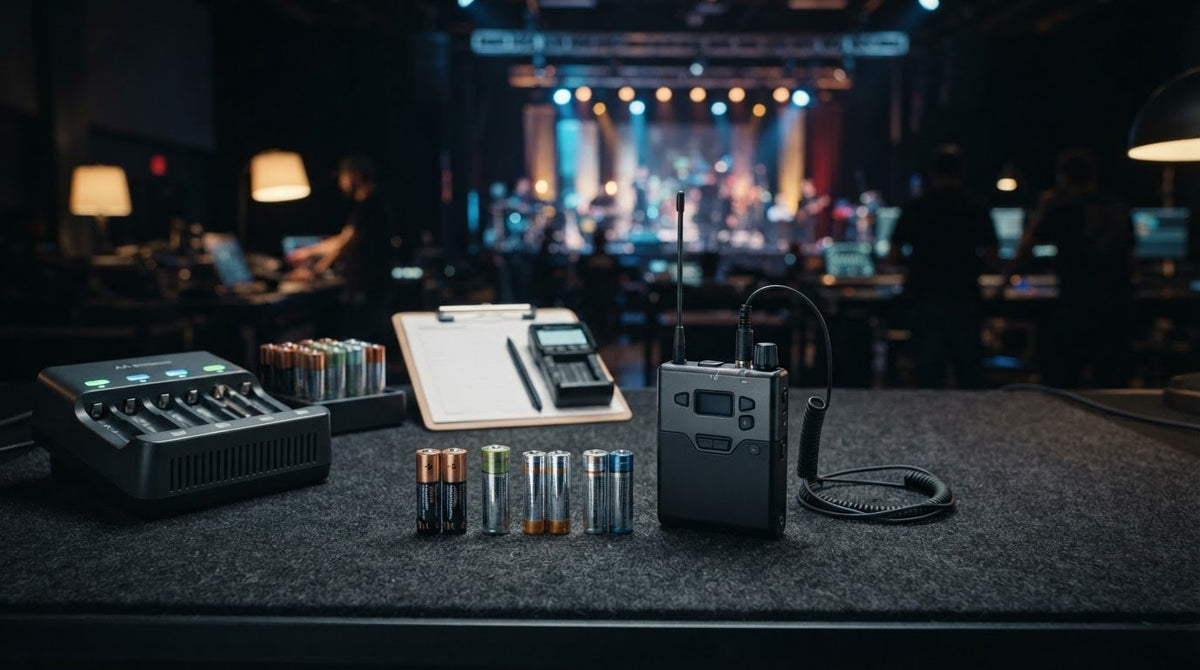
What if the AA cell with the biggest capacity rating still isn’t the right choice for your intercom beltpack? Choosing high-performance AA cells for wireless intercom beltpacks means looking beyond the mAh figure. Chemistry, voltage behavior, exact model compatibility, and the demands of each shift all affect whether a cell is suitable. A mismatch can make it difficult to predict runtime or decide how many charged spares to prepare.
That uncertainty complicates scheduling, especially when several team members rely on working beltpacks throughout a production. Runtime matters, but so does a practical charging and rotation routine. This guide explains how to check cell specifications against the beltpack manufacturer’s requirements, compare options using relevant performance evidence, and plan charging and spares around actual operating patterns.
You’ll also learn what to consider across alkaline, lithium, NiMH, and 1.5V rechargeable lithium cells, without assuming one chemistry suits every device. The goal is a compatible battery choice and a clear workflow for keeping charged cells ready when your team needs them.
Key Takeaways
- Check the exact beltpack manual before selecting a cell. Approved chemistry, voltage, and dimensions matter more than a headline capacity rating.
- Compare high-performance AA cells for wireless intercom beltpacks using verified specifications and runtime tests in the conditions your team actually works in.
- Build a repeatable deployment routine: test candidate cells, record results, and set a consistent charging and rotation process.
- Plan charged spares around measured runtime and shift patterns, rather than relying on estimated hours from mAh alone.
- Horizon Battery has operated since 1998 and offers rechargeable AA cells, charger bundles, rackmount chargers, and battery storage to support battery planning.
What High-Performance AA Cells Need to Deliver in Wireless Intercom Beltpacks
For a wireless intercom beltpack, “high-performance” doesn’t simply mean the largest capacity printed on the label. It means dependable operation with a cell the manufacturer approves, for the work period your team needs to cover. The right choice must meet the beltpack’s electrical and physical requirements and perform reliably under the conditions in which the device is used.
Quotable definition: High-performance AA cells are cells verified for the exact beltpack and operating conditions, with tested runtime that supports the planned shift; capacity alone can’t prove beltpack performance.
Runtime varies with the beltpack model, transmitter settings, how often it’s active, and operating conditions. Two cells with similar advertised capacity may therefore perform differently in use. Treat capacity as a comparison specification, not a promise of operating hours. For a useful comparison, test cells in the same beltpack with consistent settings, usage patterns, and conditions, and record the results.
Which beltpack specifications should buyers check first?
Start with the intercom manufacturer and the exact beltpack model. Read its manual before comparing cells. Check the permitted chemistry, voltage, physical size, and replacement guidance, then confirm the unit accepts standard AA cells rather than a proprietary battery pack. Don’t assume a cell is suitable because it fits the compartment or is marketed for wireless microphones. Compatibility must be established for the specific beltpack.
Why does dependable power matter during a production shift?
An unexpected loss of power can interrupt communication when crew members need to coordinate. Your battery plan depends on how long each beltpack must remain in service and whether charged spares are accessible during the shift. A team with planned changeovers may have different needs from one that relies on a beltpack continuously. Use representative testing to estimate when replacements may be needed, then plan spares around the work schedule rather than a generic runtime claim.
Rechargeable options also require a compatible charging approach and a repeatable process for keeping ready cells available. The rechargeable battery technologies overview provides background on chemistries and charging concepts, but it doesn’t establish compatibility with a particular intercom. The beltpack manual and documented tests should guide that decision.
When evaluating high-performance AA cells for wireless intercom beltpacks, keep the process tied to the actual work: verify compatibility first, then compare runtime evidence gathered under consistent conditions. That gives teams a sounder basis for choosing cells and preparing spares than a capacity label alone.
AA Cell Chemistry, Voltage, and Capacity: What the Numbers Mean for Beltpacks
Battery labels help narrow the options, but they don’t establish whether a cell will work in a particular beltpack. Milliamp-hours (mAh) describe a cell’s rated capacity under specified test conditions. They don’t translate directly into operating hours, because runtime also depends on the device load and how the beltpack is used.
Rated capacity is a test-based measure of charge, while real-world runtime is the time a specific beltpack operates under defined conditions. Compare capacity figures only when products use comparable test methods, then check the exact beltpack manual for permitted chemistry and voltage.
| Cell type | Voltage information | Capacity information | Compatibility check |
|---|---|---|---|
| Alkaline | Typically labeled 1.5 V nominal; verify product documentation. | Check the current cell documentation and test conditions. | Confirm alkaline chemistry and voltage are approved by the beltpack maker. |
| Primary lithium | Typically labeled 1.5 V nominal; verify product documentation. | Check the current cell documentation and test conditions. | Confirm the manual permits this chemistry and cell format. |
| NiMH rechargeable | Typically 1.2 V nominal; verify the specific cell documentation. | Compare mAh ratings only when test methods are comparable. | Check that the beltpack supports the voltage and rechargeable chemistry. |
| Rechargeable lithium-ion AA | Some products specify regulated 1.5 V output. Verify output and cell details. | Check the stated capacity, units, and test conditions. | Confirm the AA format, voltage behavior, and charging requirements are approved. |
How do NiMH and lithium-ion AA cells differ for this application?
NiMH and lithium-ion are different rechargeable chemistries, with different voltage characteristics and charging requirements. A lithium-ion AA product labeled for 1.5 V output may use voltage regulation, so don’t assume its electrical behavior or charging method matches a conventional AA cell. Battery University offers background on how to compare AA cells by application. For beltpack use, the manual’s approved chemistry and voltage range remain decisive.
Does a higher mAh rating mean longer intercom runtime?
Not necessarily. Load, temperature, cell condition, beltpack settings, and differences in capacity test methods can all affect results. For a useful comparison, log actual operating hours using the same beltpack, settings, and representative usage pattern. That provides better evidence than comparing label figures alone.
Once you’ve confirmed the beltpack requirements, you can review high-capacity rechargeable AA batteries as one category to evaluate. Verify the specifications and charging needs of any candidate before deployment.
How to Compare AA Cells for Wireless Intercom Beltpacks
A useful comparison starts with the exact beltpack requirements, then checks whether each candidate cell and charger fit the team’s workflow. For high-performance AA cells for wireless intercom beltpacks, verified compatibility and repeatable runtime results matter more than the largest advertised capacity. Use a comparison matrix to keep the evidence consistent across options.
| Comparison point | What to record | What to verify |
|---|---|---|
| Approved chemistry | Cell chemistry stated in product documentation | Whether the beltpack manual permits it |
| Voltage | Nominal and, where specified, regulated output | Whether it falls within the beltpack maker’s requirements |
| Capacity | Rating, units, and test method if provided | Whether ratings were measured comparably; don’t treat mAh as runtime |
| Dimensions | Published cell size | Fit in the beltpack’s AA compartment |
| Charger | Required charger type and charging guidance | Compatibility with the cell and team’s charging setup |
| Performance evidence | Elapsed operating time and test conditions | Same beltpack model, settings, and representative use |
Also consider consistency between cells, whether replacements can be sourced when needed, and how staff will distinguish charged sets from used ones. A simple label or designated storage location can make cell status easier to identify during handoffs. For broader selection context, see this professional audio battery comparison guide.
What evidence makes a runtime claim useful?
Ask whether the test used the same beltpack model, settings, and operating conditions your team expects. A capacity figure alone isn’t an elapsed runtime result. Record the test setup and operating hours so another candidate can be compared on equal terms. Treat claims without stated methods, and anecdotal results from different setups, as unverified rather than equivalent evidence.
How should rechargeable cells compare with disposable AA batteries?
Compare the complete workflow, not just cell ratings. Consider charging access, how quickly cells can be made ready, spare-cell planning, and how replacements will be managed. The right fit depends on the operation. Avoid assuming rechargeable cells will reduce costs or environmental impact without current evidence tied to your usage and replacement pattern. For broader organizational considerations, read this business guide to switching to rechargeable batteries.
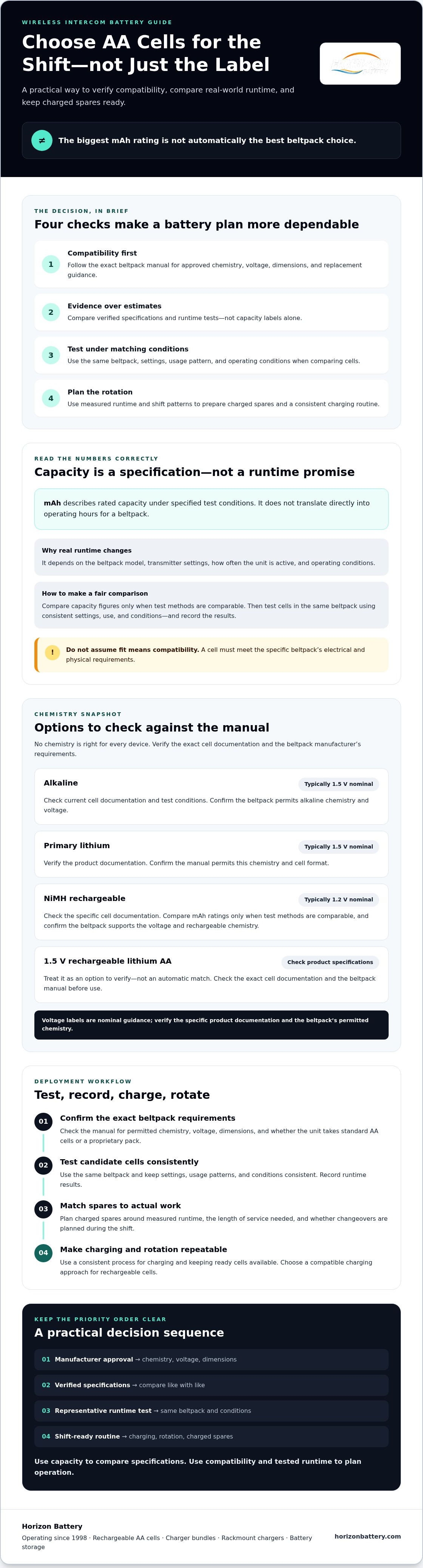
How to Test, Charge, and Rotate Beltpack AA Cells Before Deployment
A controlled trial helps turn battery selection into a repeatable team process. Test candidate cells in the exact beltpack model, using representative settings and work conditions. Keep the procedure consistent so the results are useful, then standardize how cells are charged, identified, and rotated.
How can a team run a practical beltpack battery trial?
- Verify compatibility. Check the beltpack manual and confirm the candidate cells meet its permitted chemistry, voltage, and size requirements.
- Identify a test set. Keep the candidate cells together and clearly marked so they won’t be mixed with cells already in service.
- Test under representative conditions. Use the exact beltpack model with the settings and work pattern the team expects during production.
- Record the result. Note the beltpack model, settings, start time, elapsed operating time, and relevant conditions, such as changes in use or environment.
- Repeat and review. Run the procedure again before treating a result as representative or making a fleet-wide choice. Keep the test notes with the cell identification.
Consistent records make it easier to compare candidates and spot differences between trials. For broader inventory practices, see the professional battery storage and management system guide.
What charging and spare-cell routine reduces avoidable downtime?
Use a charger intended for the selected cell type and follow both the cell and charger instructions. Don’t assume a charger is suitable simply because the cells share an AA form factor. For multi-user charging plans, the enterprise battery charging solutions guide offers broader planning context.
Make cell status obvious at a glance. Store charged, in-use, depleted, and untested cells in separate, clearly labeled locations or containers. This separation helps prevent an untested or depleted cell from being mistaken for a ready spare during a handoff. Set a consistent return-and-charge routine that fits the team’s shift pattern, and make one process owner responsible for keeping the rotation clear.
Testing high-performance AA cells for wireless intercom beltpacks is only part of deployment. A reliable routine also depends on compatible charging and orderly storage. Review rechargeable AA cells and charger options as you plan a configuration around your beltpack model and operating pattern.
Choosing a Reliable AA Battery Source for Intercom Beltpacks
A dependable source should help you evaluate the cell, charger, and operating routine as a complete setup, without substituting general product claims for beltpack-specific verification. Before selecting high-performance AA cells for wireless intercom beltpacks, use this checklist:
- Manual compatibility: Confirm the exact beltpack model and its approved cell chemistry, voltage, and size.
- Verified specifications: Check current product documentation for cell chemistry, voltage, capacity, dimensions, and charging requirements.
- Trial results: Use repeatable tests in the intended beltpack and work conditions to inform runtime expectations.
- Charger fit: Confirm the charger is suitable for the selected cell type and follow its instructions.
- Team workflow: Plan how charged, in-use, depleted, and untested cells will be labeled, stored, and rotated.
Horizon Battery is a specialist distributor that has operated since 1998. Its offerings include rechargeable AA cells, charger and battery bundles, and battery storage. These product categories can support a team’s battery planning, but compatibility and runtime still need to be confirmed against the beltpack documentation and your own test results.
When should buyers consider a battery-and-charger bundle?
A bundle may be worth considering when a team needs cells and charging equipment as part of one coordinated setup. Check the current product details before ordering: confirm that the charger is appropriate for the exact cell chemistry and specifications, and don’t assume a listed bundle suits a particular beltpack without verifying each component. The beltpack manual and cell documentation should guide the choice.
What should an intercom buyer confirm before ordering?
Share the exact beltpack model, its approved chemistry and voltage range, and the expected operating schedule when reviewing options. Confirm current cell and charger specifications, along with product availability, directly before purchase. For larger teams, assess charging capacity, labeling, storage, and replacement procedures together so the selected equipment fits the actual rotation plan.
Once you’ve confirmed your requirements, explore Horizon Battery’s rechargeable AA options. Compare the documented specifications with your beltpack manual and trial results before choosing a configuration.
Build a Battery Plan Your Crew Can Rely On
Reliable intercom power starts with the beltpack manual, not the biggest capacity claim. Confirm approved chemistry, voltage, and cell size, then compare candidates through consistent runtime tests in the exact beltpack and representative working conditions. Use the results to plan charged spares around expected changeovers and establish a clear charging, labeling, and rotation routine for the team.
Choosing high-performance AA cells for wireless intercom beltpacks is a system decision: compatible cells, suitable charging, and an organized workflow all contribute to dependable operation. Keep specifications and test records together so future cell comparisons are based on your equipment and actual use.
Horizon Battery is a specialist mobile-energy product distributor operating since 1998. Its offerings include rechargeable AA cells, charger and battery bundles, custom rackmount chargers, and battery storage. Confirm product specifications against your beltpack requirements, then explore Horizon Battery’s rechargeable AA options as you plan your setup. Start by checking your beltpack model and comparing the documented product specifications with your test results.
Frequently Asked Questions
Is a rechargeable AA cell suitable for a wireless intercom beltpack?
Yes, a rechargeable AA cell can be suitable if the beltpack manufacturer permits its chemistry, voltage, and format. Check the manual for the exact model before buying, since support for one rechargeable type doesn’t mean every rechargeable AA will work. Then test a small, clearly identified set under representative working conditions. Compare measured operating time and charging or handling needs with your shift plan, rather than relying on broad claims about rechargeable cells.
Can I use lithium-ion AA cells in a wireless intercom beltpack?
Only if the beltpack manufacturer explicitly supports that cell type and its voltage behavior. AA-size lithium-ion products can differ in chemistry and electrical design, so fitting the battery compartment doesn’t confirm compatibility. Check both the beltpack manual and the cell’s current product documentation. If either leaves a question unanswered, ask the equipment maker or supplier before use. Don’t assume lithium-ion AA cells are interchangeable with other rechargeable AA chemistries.
How long do AA cells last in a wireless intercom beltpack?
There’s no single dependable runtime for every beltpack. Operating time depends on the model, cell chemistry and condition, settings, usage pattern, and test conditions. Use manufacturer guidance as a starting point, then measure runtime in the exact beltpack during a representative work period. Record the settings and conditions, and repeat the test. Use those results to plan spare-cell quantities and shift procedures instead of relying on a general runtime estimate.
Does a higher mAh rating mean an AA cell will last longer in my beltpack?
Not necessarily. A higher mAh figure indicates rated capacity under specified test conditions, but it doesn’t directly predict operating hours in a particular beltpack. Capacity ratings may also come from different test methods, making a simple label-to-label comparison unreliable. First confirm that the chemistry and voltage are compatible. Then compare candidates using consistent tests in the same beltpack. Treat runtime claims without clear test conditions as estimates, not guarantees.
Can I mix different AA cell types or charge levels in one beltpack?
Avoid mixing chemistries, brands, ages, or charge states unless the beltpack manufacturer specifically permits it. Cells that behave differently can make performance less predictable and complicate decisions about when to replace them. Follow the device manual and use matched sets where directed. For team use, label cells and keep charged, in-use, depleted, and untested sets separate. A clear rotation routine helps reduce handling errors during busy handoffs.
How should I charge rechargeable AA cells for intercom use?
Use a charger specified for the exact cell chemistry and follow the charger and battery instructions. AA size alone doesn’t establish charger compatibility. Check product documentation for cell-specific charging or handling limits, and make sure the routine fits the team’s work schedule. For shared inventory, label cells and keep charged, depleted, and untested sets distinct. This makes it easier to identify ready spares and return used cells to the correct charging process.
What should I check before buying AA cells for a professional intercom system?
Identify the exact beltpack model and check its approved cell format, chemistry, and voltage requirements. Then verify the candidate cells’ current specifications and compare any repeatable runtime evidence from the same equipment and conditions. Confirm charger suitability, replacement availability, and the team’s storage and rotation needs. If the manual or product documentation doesn’t resolve a compatibility question, check with the equipment maker or a specialist supplier before ordering.