
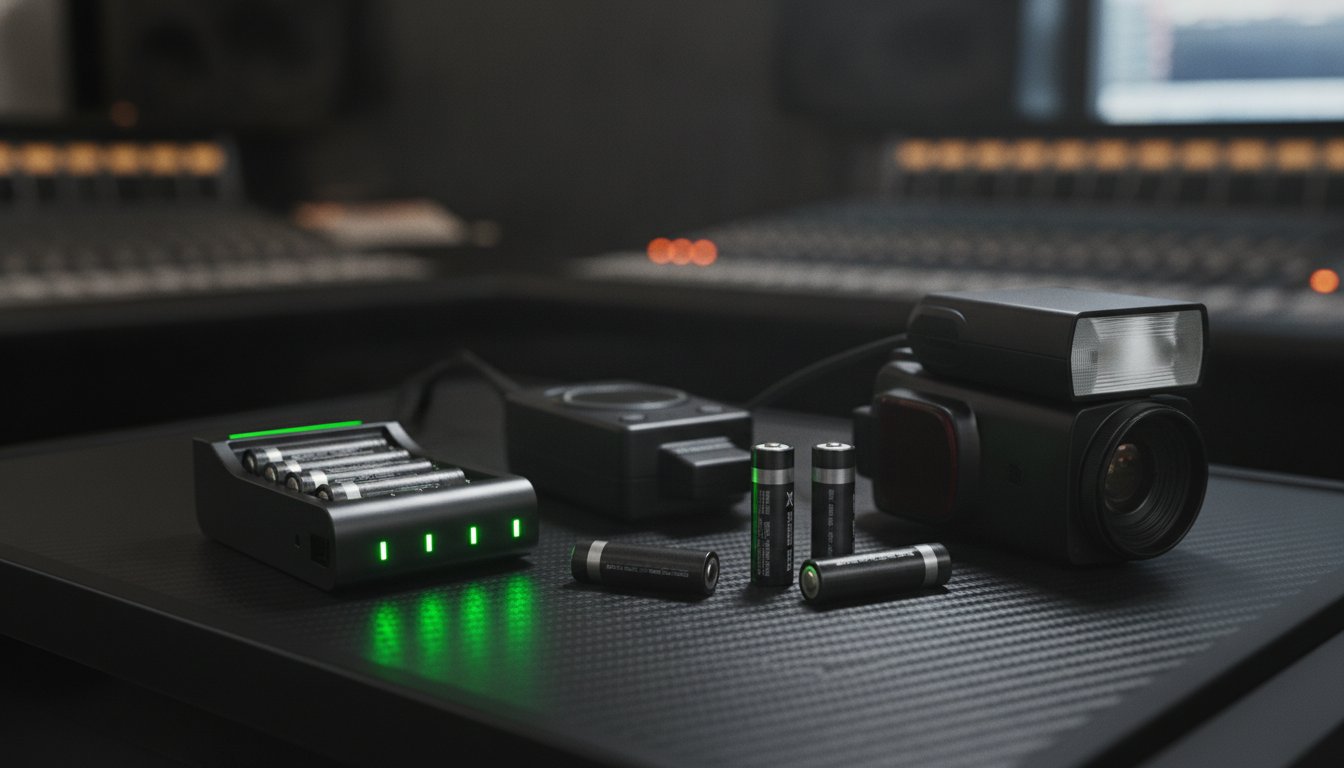
A high mAh rating on a battery label often provides a false sense of security for professional users. While a high capacity sounds impressive, it doesn't guarantee that a cell can handle the rapid energy spikes required by modern professional gear. You've likely experienced the frustration of a wireless microphone or camera flash failing mid-assignment, even though the batteries were recently installed. It's an expensive cycle to constantly replace disposable alkalines, and the technical jargon around milliamp hours often fails to explain why some batteries fail under heavy loads.
We understand that reliability is your primary requirement. This guide will help you identify the best AA batteries for high drain devices by focusing on voltage stability and low internal resistance. You'll discover which chemistries deliver the consistent power required for mission-critical electronics and how to lower your long-term operating costs. We'll examine the 2026 shift toward 1.5V Li-ion rechargeables and high-capacity NiMH options like our Pure Power Series to ensure your equipment maintains peak performance with minimal downtime. By the end of this article, you'll know exactly which power solution fits your specific professional application.
Key Takeaways
- High-drain devices like wireless transmitters require consistent voltage. Learn why standard batteries suffer from "voltage sag" and fail prematurely under heavy loads.
- We compare NiMH, Lithium, and Alkaline chemistries to help you select the best AA batteries for high drain devices based on your specific professional requirements.
- Don't rely on mAh ratings alone. Discover how to balance high capacity with low internal resistance to prevent gear from shutting down during critical moments.
- Proper maintenance extends the life of your investment. We explain how smart chargers and custom rackmount systems prevent heat damage and ensure maximum cycle life.
- Transitioning from disposables to high-capacity NiMH rechargeables like the Pure Power Series reduces long-term costs while providing dependable power for mission-critical gear.
What Defines a High Drain Device and Why Standard Batteries Fail?
High drain devices are defined by their need for rapid energy delivery. Unlike a wall clock that sips power over several years, high-performance electronics pull massive amounts of current in short bursts or require sustained high-wattage output to function. If you're searching for the best AA batteries for high drain devices, you've likely noticed that standard alkaline cells often trigger "low battery" warnings within minutes of use. This happens despite the battery having plenty of total energy left inside. The issue isn't capacity; it's the speed of delivery.
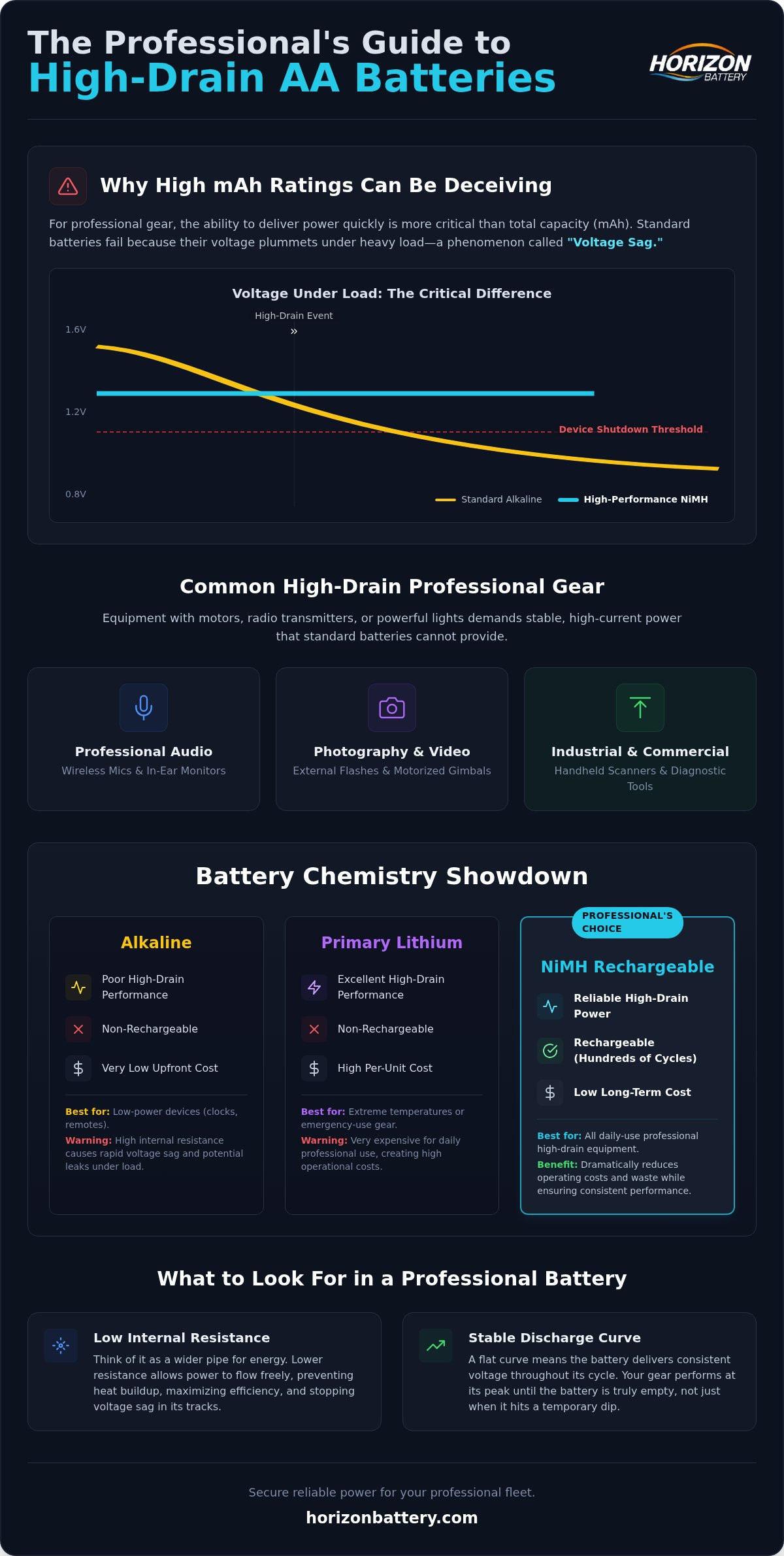
When a device demands a sudden surge of power, the battery's voltage naturally dips. This phenomenon is known as voltage sag. In high-drain applications, this dip can be so severe that the voltage falls below the device's operational threshold. The equipment shuts down prematurely because the battery chemistry can't keep up with the demand. This is the primary reason why professional gear requires specialized cells with stable discharge curves rather than cheap, consumer-grade alternatives.
Common High Drain Applications
Professionals encounter high-drain scenarios across several mission-critical fields where power failure isn't an option:
- Professional Audio: Wireless microphone transmitters and In-Ear Monitor (IEM) systems require constant, stable voltage to maintain signal integrity and prevent audio dropouts during a performance.
- Photography: External speedlights and motorized camera gimbals draw intense bursts of current to recycle flashes or move heavy lenses quickly.
- Industrial Use: Handheld inventory scanners and specialized diagnostic tools often run high-brightness displays and laser sensors that drain standard batteries in a matter of hours.
The Science of Internal Resistance
Internal resistance is the friction that prevents energy flow. In high-performance battery design, low internal resistance is the secret to reliability. High resistance acts like a bottleneck; it forces the battery to work harder to push energy out, which generates excessive heat. This heat buildup doesn't just waste energy; it actively damages the internal chemistry and shortens the overall lifespan of the cell.
Modern Nickel-Metal Hydride (NiMH) solutions, such as our Pure Power Series, are engineered with materials that facilitate faster electron movement. This specialized construction ensures that the best AA batteries for high drain devices maintain their voltage even when pushed to the limit. Identifying your gear's requirements is the first step toward operational efficiency. If your device involves motors, radio transmission, or intense lighting, it is a high-drain device that will consistently underperform with standard alkaline cells.
Battery Chemistry Showdown: NiMH vs. Lithium vs. Alkaline
Selecting the right chemistry is the most critical decision for any technician or operator. While alkaline, primary lithium, and NiMH cells share the same physical dimensions, their performance profiles under load are vastly different. The best AA batteries for high drain devices are those that maintain a flat discharge curve, ensuring your equipment receives steady power until the cell is actually depleted. Understanding these chemical differences prevents equipment failure and reduces operational overhead.
Primary lithium batteries, such as the Energizer Ultimate Lithium, represent the peak of single-use performance. They handle high-current demands with ease and perform exceptionally well in extreme temperatures. However, they're non-rechargeable and carry a high price point per unit. For professionals running gear daily, the cost of primary lithium is often difficult to justify. This is why high-capacity Nickel-Metal Hydride (NiMH) has become the industry standard for sustained, cost-effective power.
Why Alkaline Batteries Fail Under Load
Alkaline batteries rely on a zinc-manganese dioxide chemistry that was never intended for rapid discharge. When a high-drain device pulls current, the chemical reaction inside an alkaline cell can't keep pace. This leads to the "alkaline slide," where voltage drops almost immediately upon use. This inefficiency generates significant heat, which increases the risk of the potassium hydroxide electrolyte leaking and damaging your expensive electronics.
Beyond the technical failure, alkalines represent a significant hidden cost. You might pay less upfront, but the short runtime in professional gear means you'll use five to ten times as many batteries compared to a single NiMH charge. If you're looking to upgrade your power management, exploring our Pure Power Series can provide the industrial reliability your gear demands without the constant waste of disposables.
NiMH: The High-Drain Workhorse
Modern NiMH technology is engineered specifically for consistency. For professional applications like wireless audio or photography, a capacity of 2500mAh or higher is the sweet spot. This provides enough overhead for long duty cycles while maintaining the low internal resistance necessary for high-current bursts. Unlike older rechargeable technologies, modern cells feature Low Self-Discharge (LSD) chemistry. This allows them to retain most of their charge for months while sitting in a gear bag or storage locker.
Switching to NiMH also addresses environmental and logistical concerns. A single high-quality NiMH battery can replace hundreds of alkalines over its lifespan. For professionals interested in further sustainable energy solutions, Top Solar Gear offers reviews and buying guides for solar-powered equipment that can complement your portable power needs. This reduces the physical footprint of your battery inventory and eliminates the need for frequent bulk disposals. In a professional environment, this transition leads to lower long-term operating costs and significantly less downtime for your crew.
Key Features to Look for in Professional AA Rechargeable Batteries
Identifying the best AA batteries for high drain devices requires looking past the bold numbers on the retail packaging. While consumer marketing often fixates on a single capacity rating, professionals must evaluate a battery's ability to maintain performance under stress. A high-capacity cell that cannot sustain its voltage during a high-current burst is essentially useless for mission-critical gear. You need a balanced power solution that considers discharge rates, cycle life, and environmental resilience.
Cycle life is a primary concern for high-volume users. A battery that performs well for the first ten charges but degrades rapidly afterward increases your long-term costs. Professional NiMH cells are typically rated for hundreds of recharge cycles while maintaining a significant percentage of their original capacity. Temperature resistance also plays a vital role. Whether you're operating in a freezing outdoor environment or under the intense heat of stage lighting, your batteries must maintain stable chemistry to prevent sudden equipment shutdown.
Decoding Battery Labels
The mAh (milliamp hour) rating on a label represents the total energy "fuel tank" of the battery. However, it doesn't tell you how quickly that energy can be accessed. Some ultra-high capacity batteries achieve their ratings by using thinner internal components, which can actually increase internal resistance. For the best AA batteries for high drain devices, look for a combination of high capacity and Low Self-Discharge (LSD) technology. LSD ensures your backup gear remains ready for use even if it has been sitting in a storage case for several weeks.
The Importance of Cell Matching
Most professional devices, such as external camera flashes or wireless receivers, utilize multiple batteries in a series. In these configurations, the entire set is only as strong as its weakest cell. If one battery in a four-pack has higher resistance or lower capacity, it will drain faster than the others. This creates a bottleneck that triggers low-battery warnings prematurely, even if the other three cells are still healthy.
Horizon Battery prioritizes consistency in our Pure Power Series to ensure that every cell in a batch performs within a narrow tolerance range. This level of precision is what separates industrial-grade power from standard consumer rechargeables. To maximize your investment, we recommend "marrying" your battery sets. Mark each set with a unique identifier, such as "Set A" or "Set B," and keep those specific cells together throughout their entire service life. This simple habit prevents mismatched performance and extends the overall utility of your battery inventory.
Maximizing Battery Lifespan in Professional Environments
Even the best AA batteries for high drain devices will underperform if they aren't maintained with professional-grade hardware. Proper maintenance is the difference between a battery that lasts three years and one that fails after six months. Smart chargers are the foundation of any battery management protocol. These units utilize negative delta voltage (-dV) detection to stop the charging process the moment a cell is full. This prevents overcharging, which is the primary cause of electrolyte breakdown and permanent capacity loss.
Heat is the most significant threat to battery health. When a cell charges or discharges too rapidly, internal temperatures rise, increasing internal resistance over time. To protect your investment, you must ensure your charging environment is well-ventilated and your hardware is capable of monitoring individual cell temperatures. Recognizing when to retire a battery is equally important. If a cell consistently feels hotter than others in the set during charging, or if it triggers a "fault" light on your smart charger, it's time to pull it from professional rotation.
Charging Strategies for High-Drain Cells
Individual channel charging is a non-negotiable requirement for professional fleets. Budget chargers often charge batteries in pairs, which leads to unbalanced cells and shortened lifespans. By charging each battery independently, you ensure every cell reaches its peak capacity without being limited by a weaker neighbor. While fast charging is convenient, a moderate charge rate is generally better for long-term chemistry stability.
For organizations managing dozens of wireless channels, standard desktop chargers create a logistical bottleneck. Centralizing your power management with specialized hardware improves efficiency and reduces the risk of misplaced gear. To streamline your operations and ensure your fleet is always ready, consider our Custom Rackmount Chargers for high-volume deployments.
Inventory Management for Large Fleets
Managing a large inventory requires a methodical approach to rotation. Implementing a First-In, First-Out (FIFO) system ensures that no single set of batteries sits idle for too long while others are over-taxed. We recommend dating every new set of batteries with a fine-tip permanent marker the day they enter service. This allows you to track the age of your fleet and predict when a batch might need replacement based on its service history.
Organization prevents accidental short-circuits and keeps terminals clean. Use dedicated battery storage cases rather than keeping loose cells in a drawer or gear bag. These cases protect the terminals from coming into contact with metal objects, which can cause a rapid discharge or fire hazard. Color-coding your battery sets also helps technicians quickly identify which packs are fresh and which are depleted during a high-pressure event.
Since 1998, Horizon Battery has focused on the specific power requirements of the professional audio and production industries. We've seen the market evolve from basic alkaline use to the sophisticated rechargeable systems used today. For those seeking the best AA batteries for high drain devices, our Pure Power Series represents a specialized solution engineered for mission-critical reliability. While standard retail batteries are designed for general consumer use, our cells are built to handle the rigorous duty cycles of professional wireless microphone systems and high-output electronics. The primary difference lies in the internal architecture. Pure Power cells are manufactured with a focus on low internal resistance; this prevents the voltage sag that often plagues cheaper alternatives. This engineering ensures a consistent 1.2V delivery throughout the majority of the discharge cycle. When your gear demands a sudden burst of current, these batteries respond without the excessive heat buildup that can degrade standard rechargeables. This steady performance is why churches, theaters, and production companies across North America have relied on our hardware for over two decades.The Pure Power Advantage
Professional environments require predictable runtimes. In high-stress tests, Pure Power cells consistently outperform standard retail rechargeables by maintaining their voltage longer under heavy loads. This translates to more reliable performance for wireless microphones and IEM systems, where even a minor drop in power can cause signal dropouts. We offer these cells in various configurations to suit your specific needs. You can explore our Pure Power Series bundles to find the right combination of high-capacity cells and storage solutions for your team.
Comprehensive Support and Solutions
We provide more than just individual cells. Our team delivers complete power management systems designed for large-scale operations. For schools, houses of worship, and production houses, we offer expert consultation to help design an efficient battery rotation. Our solutions include custom rackmount chargers that centralize your power needs and eliminate the clutter of multiple desktop units. We support these offerings with direct national shipping across the United States and Canada, ensuring your facility stays powered regardless of its location. Our role is to act as a seasoned partner, helping you find the most cost-effective and reliable power solutions for your specific professional applications.
Securing Reliable Power for Your Professional Fleet
Maintaining high-performance electronics requires moving beyond the limitations of standard alkaline cells. You now understand how internal resistance and voltage sag determine real-world performance in professional gear. By prioritizing stable chemistry and disciplined inventory management, you can eliminate the risk of equipment failure during critical moments. Selecting the best AA batteries for high drain devices is about balancing high capacity with the low internal resistance found in industrial-grade NiMH technology.
Horizon Battery has served professional audio and industrial clients since 1998. We provide custom-engineered solutions like the Pure Power Series and specialized rackmount charging hardware designed to handle the most demanding environments. We focus on the technical precision required for mission-critical applications so your team can stay focused on the task at hand. It's time to stop overspending on disposables and start investing in power you can trust.
Upgrade your gear with professional high-capacity AA battery bundles at Horizon Battery
Frequently Asked Questions
Can I use rechargeable NiMH batteries in any high-drain device?
Yes, modern NiMH batteries are compatible with almost all high-drain electronics designed for AA cells. While they provide a nominal 1.2V compared to the 1.5V of alkalines, their low internal resistance allows them to maintain that voltage under heavy load. This makes them more reliable for devices like wireless microphones and motorized equipment than standard disposable cells that suffer from immediate voltage drops.
Do high-capacity AA batteries take longer to charge?
Generally, yes, because there is more energy to replenish within the cell. A 2850mAh battery requires more time on the charger than a 2000mAh cell if the charging current remains the same. Using a smart charger allows you to manage this process safely; it ensures the high-capacity cells are fully saturated without risking the heat damage often caused by over-accelerated charging cycles.
Why do my batteries get hot when I use them in my camera flash?
Rapid energy discharge creates heat as a natural byproduct of internal resistance. Camera flashes draw immense current to recycle the capacitor quickly, forcing the battery to work at its maximum threshold. High-quality cells designed as the best AA batteries for high drain devices minimize this heat through superior internal construction, though some warmth is expected during periods of intense, rapid-fire use.
Are lithium AA batteries better than NiMH for professional audio gear?
Non-rechargeable lithium batteries offer excellent shelf life and light weight, but NiMH is often preferred for professional audio due to cost-efficiency and predictable discharge. While primary lithium cells have a higher upfront voltage, the consistent performance and rechargeability of our Pure Power Series make them a more sustainable choice. They provide the steady current needed for wireless transmitters and IEMs without the high cost of disposables.
How many years do professional AA rechargeable batteries last?
A professional NiMH battery typically lasts between two to five years depending on the frequency of use and your specific charging habits. Longevity is measured in charge cycles; most high-capacity cells provide several hundred cycles before capacity drops below 80% of the original rating. Proper storage and avoiding extreme heat are the most effective ways to ensure your battery fleet reaches its maximum operational lifespan.
What is the difference between consumer and professional-grade NiMH batteries?
Professional-grade batteries are manufactured with tighter tolerances and lower internal resistance than standard retail versions. These cells are optimized for consistent voltage delivery under heavy load rather than just long shelf life in low-drain devices. This ensures that every battery in a matched set performs identically; this is a critical requirement for the complex circuitry found in professional-grade production hardware.
Can high-drain devices be damaged by using the wrong type of battery?
While rare, damage can occur if a battery leaks or if an incorrect voltage profile causes the device to overheat. Alkaline batteries are particularly prone to leaking when they are over-taxed by high-drain demands. Using the best AA batteries for high drain devices protects your investment by providing a stable power source that won't corrode the internal contacts of your expensive electronics.
How should I store my rechargeable batteries when they aren't in use?
Store your batteries in a cool, dry place inside a dedicated storage case to prevent the terminals from short-circuiting. For long-term storage, it is best to keep NiMH cells at approximately 40% to 50% charge rather than leaving them completely depleted. This practice maintains the chemical health of the cell and ensures they are ready for a full charge when your next project begins.